- Pp. 178-179 in the Borg book which explain there is “first hand religion” that we develop on our own from our own experiences, and “2nd hand religion” which is what is told us by others.
- from the Marigold Hotel movie: “if things haven’t ended in a good way, then it isn’t the end yet” (or something like that).
- As we travel through life somewhat burdened with taking care of others, one wonders, “When will it be MY turn?” — BUT, there may be a time later in life when we must depend on others to take care of us totally, so embrace all that we can do now—that may be part of our purpose.
- Our purpose often just unfolds as we travel through our lifetime
- We can look backwards on life and realize we have had impact, we have had purpose (the George Bailey factor)
- When reading Eccleisastes 3: 1-8, read the phrases as inclusive aspects of life, not as THIS and/or THAT: “[in life] there is a time to weep AND a time to laugh” — This is living life fully… When we accept the good and the bad, as both are important in developing acceptance of that which one cannot change
- We need to learn this in order to develop the ability to accept the changes (and losses and thereby mourning) that comes from aging.
Uncategorized
Source to Marcus Borg speech delivered in Irvine, CA 6/1-3/2000

Can anyone give me a summary of the book of Amos in the bible?
Week 6 – Updates
Thank you, Bet, for leading on Lesson 6 today. Those who can’t be with us are always missed. Among other things, we completed the exercise on page 29 about various social analyses. It was certainly a lesson that could have continued for another 40 or more minutes! Good dialogues. We all enjoyed sharing our civil observations today, the laughter, the deep insights, the probing questions, the sharing, and the coffee, pumpkin butter and scones (Marsha and Jim are enjoying the leftovers!).
Highlights from Borg’s video: Consider reading Amos. Borg mentioned this was the chapter that changed his attitude about the Bible, and where he realized the passion in the Bible is for THIS world. Borg noted that the Bible is filled with “God-intoxicated voices of social protest against oppression…. The Bible calls for a different kind of world. This is God’s passion.”
The Bible and Congressman Broun – Rev. Adam Hamilton
U.S. Congressman Paul Broun of Georgia recently noted in a speech at Liberty University that evolution and much else he was taught in college were “lies straight from the pit of hell.” These were “lies to try to keep me and all the folks who were taught that from understanding that they need a savior.” He went on to note that he believes that the earth is about 9,000 years old and was created in six days because this is what the Bible says. He noted that the Bible is “the manufacturer’s handbook” and “it teaches us how to run all of public policy and everything in our society.”
Congressman Broun is not alone in his views. Forty-six percent of Americans in the latest Gallup poll reported believing human beings did not evolve but were created as they are today less than 10,000 years ago. A large number of earnest Christians reject evolution, believe in a young earth, see the Bible as the “manufacturer’s handbook,” and believe that it gives solid advice for public policy today.
I love the Bible. I read it every day. I spend 10 hours a week studying it. It has affected my life in profound ways. I am inspired when I read it. In its pages I find the truths that guide my daily life — truths that represent my highest ideals and greatest aspirations. I am a follower of Jesus Christ. The Bible is my primary way of knowing him and what it means to follow him. And I am a pastor and I teach and preach the Bible to my congregation every week. But the Bible is not a manufacturer’s handbook. Neither is it a science textbook nor a guidebook for public policy.
The creation story is placed at the beginning of the Bible not because God felt we needed a science lesson as a preface to the rest of the Bible. Instead it is a lesson in theology. The story is archetypal — it is intended to teach us that there is a Creator, that life is a gift and that we were created in God’s image (with the capacity to love, to make conscious decisions, to transcend our instincts, to reason). In addition it teaches that human beings were created for companionship, that sex is a blessing from God, and, in the most tragically compelling part of the story, that we human beings are drawn to do the very things that separate us from God and others (we are drawn to eat the forbidden fruit). When we do this, paradise is lost.
The story likely drew upon the best thinking of the time regarding the origins of the physical universe, but that is not the point of the passages. It is not meant to teach cosmology, or biology, geology or physics. It is teaching theology and, one could argue, anthropology, sociology and psychology. But to suggest that the creation story was intended to teach science, and that any scientific theory that contradicts these accounts is a lie “straight from the pit of hell” is to misunderstand and misrepresent these chapters.
Likewise, looking at the Bible to teach us “how to run public policy and everything in our society” is a frightening notion. Written over a period of more than 1,000 years, the biblical authors include much that today we would suggest was drawn from cultural practices and which does not reflect the “manufacturer’s” will. For instance, there are more than 300 references to slavery in the Bible. In nearly every one it is assumed that slavery was acceptable to God. Slave owners were permitted to beat their slaves with rods, provided they did not kill them or permanently maim them. Women were considered worth half the value of a man, were required to marry their rapists if their father insisted, and, in the New Testament, were to remain silent in the church. Homosexuals and disobedient children were to be stoned to death, along with adulterers.
Learning to read the Bible in the light of the times in which it was written is critical. Reading it uncritically, without understanding the cultural and historical setting of the text, leaves us forced to accept scientific and sociological norms of the ancient Near East from 3,000 years ago.
In many ways the Bible can and should act as a guide for Rep. Broun’s conscience and decision-making. But it is not as simple as saying, “the Bible says it, that settles it” (he did not say this, but many adopt this view). The words of Micah to “do justice and love kindness” are among those guides we should follow. The Golden Rule and the command to “love your neighbor as you love yourself” should shape our ethics and political views. Jesus’ Parable of the Good Samaritan and the Parable of the Sheep and the Goats each call us to show mercy and compassion for the person in need. Jesus’ own witness of sacrificial love and forgiveness, and his work to heal the sick and care for those in need represent God’s ways and vision for us.
Reading the Bible carefully, critically in the light of its historical circumstances, recognizing its humanity while hearing God speak through it, we find that we can turn to its highest aspirations and its most profound and beautiful directives while still being able to appreciate and value the insights from science and other fields of study.
Adam Hamilton is the author of ‘When Christians Get It Wrong’ (Abingdon Press) and the Senior Pastor of the 18,000-member Church of the Resurrection in the Kansas City area.
Follow Adam Hamilton on Twitter: www.twitter.com/RevAdamHamilton
Week of October 7
We’re plowing right through this study! Half way through. Thank you for leading us Sunday, DEBBIE, and for that outline you wrote on the board!
Welcome JAN! (Thanks for bringing her, Brenda*). And it was great to have SANDY FABER with us.
HIGHLIGHTS FROM SUNDAY:
Borg points out he sees 3 macro narratives that shape the Bible as a whole:
1. The exodus (which is Israel’s primal narrative—gave birth to ancient Israel with political and economic liberation)
2. Living in Exile (refers to the people’s time in Babylon
3. The Priestly period, which contains the stories of sin, guilt and sacrifice. Sacrifice leads to forgiveness.
The stories of Abraham and Sarah through Joseph and Moses, tell of yearning for fulfillment of a promise, when threats challenge our will.
These Pentateuch stories are powerful in that the address the political and the personal. Borg points out we often live in a personal bondage, and the Hebrew stories demonstrate how we have a “pharoah” within us from whom we need to be liberated from the material, social and religious messages that bind us. Stories of “promise, threat, and fulfillment” are the fiber of the exile days of the Jewish people.
Looking at the story of Moses and Exodus, experiencing liberation is a theme for all the ages. The group discussion questions 1 & 2 on page 26 of our study guide asked for several ways that we face “religious passion and social justice” today.
Finally, the issue of separation (from where we want to be) has a solution in returning, a journey to the “promised” land: When we have separation, we need reconnection.
The closing, contemporary psalm (worth reading if you haven’t) in our study guide frames what many of us feel in our times of longing: “How long, oh God, how long?” (pp26-27)
Next week we’ll look at the Prophets, chapter 6, with BET leading us. Have a great week with the beauty of the autumn colors bringing us joy in the moment.
-mc
Sept. 30 – Update
Harvest update!
The universe is amazing! Thank you, BET, for leading us on a discussion about creation today. Great job. I can’t wait to look up into (or down onto) the stars! Regretably, the telescope event mentioned was held Saturday night, Sept 29… the night everyone was commenting about today!
SUMMARY FROM SUNDAY SEPT 30 SESSION:
Words of note from Borg today:
Thomas Mann’s definition of “myth”: A story about the way things never were but always are.
2 primary meanings of the story about the fall from Eden: Hubris (puffedup pride) and Exile (alientation)
Hubris develops separation
East of Eden = a symbol for exile
Adham ~ (created from the ground) and Eve. Adham is Hebrew meaning “humankind” (also “man”)
Other things of note:
there are 2 stories about creation in the Bible: Genesis 1.1-2.3 (500s BCE); and Genesis 2.4- ch3 (900s BCE)
About “BCE” — Here’s one description in context with historical use of BC and AD:
In one respect, there really is no difference between an AD/BC and BCE/CE system when it comes to historical dates. The year 23 AD is exactly the same as the year 23 CE, and 4004 BC is also 4004 BCE. References to historical dates under either classification shouldn’t create confusion in a researcher’s mind. Major historical dates such as 1492 AD, 1776 AD or 1941 AD would still be rendered as 1492 CE, 1776 CE and 1941 CE. The AD/BC method of identifying historical dates can be traced back to Catholic historians working in the early Middle Ages. Identifying historical dates until that point was often a complicated proposition, since different historians worked under different calendars. A Roman historian would have used the Roman AUD notation, in which Year Zero was the largely symbolic founding of Rome. Converting historical dates to the standard Gregorian calendar would not have been easy. Using the birth of Jesus Christ as a central point made more sense to the religious historians.
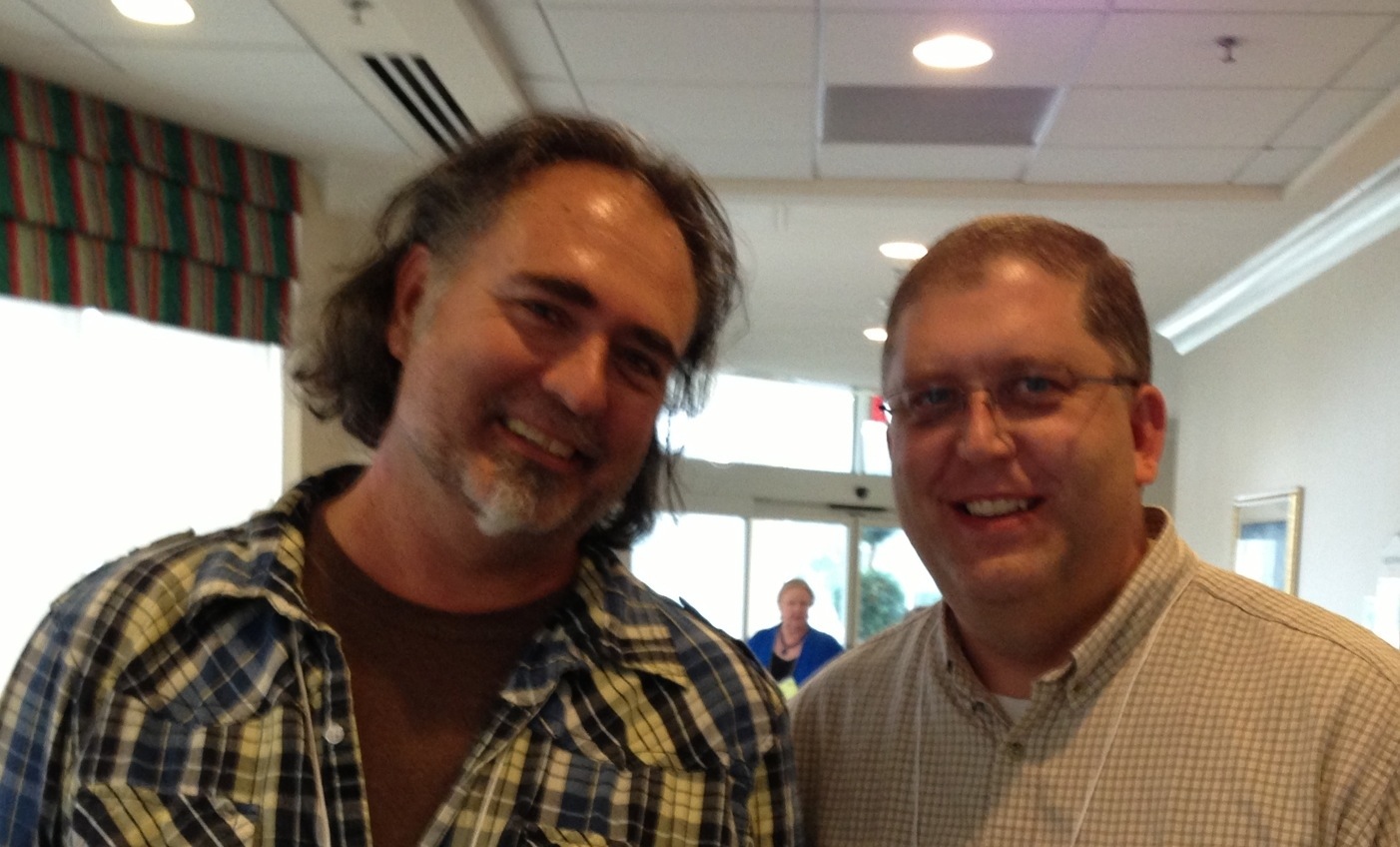
Me and Co-Founder of www.darkwoodbrew.org
Week 4 – Borg
Hello, Harvest Class. Thanks to Phyllis for leading us in discussion Sunday. She framed aspects of the Bible… such as the paraphrase versions, the translations, things not quite so… and reminded us about familiar concepts: parable, methaphor, simile; and a new concept: midrash (Jewish story building). She also helped us explore “historical” approaches to Bible texts and the “metaphorical” —-both words put together by author Borg to explain his interpretation of what much of the Bible holds and how it is applied in contemporary times. Thanks, too, Phyllis, for telling us about Josephus, and the book about him by Paul Maier. (Josephus lived during the time that the early Christian movement was taking off in the 100s, and wrote about similar concepts as found in the Bible.)
NEXT WEEK: Bet will lead us on chapter 4 about Creation.