
What is the Bible? Part 54: Predestination, Election, and that Burning Feeling in the Pit of Your Soul

Rob-Bell

A favorite excerpt from Rob Bell’s Tumblr blog series entitled – What is the Bible?  Spoiler alert the passage below is at the end of his post – so if you would like to start first at the top click here.

Always ask yourself when you come across something that religious people have been debating and discussing for years what would happen if you actually had concrete answers to the questions. 

When I have been asked whether some are chosen or not, I always ask How would you ever know such a thing? and more importantly How would that ever make your life better? 

Some things that religious people make a big deal of are rather pointless. Avoid the insanity.

How often do you ask What would it feel like to swallow a hair dryer while it was turned on? 

No, you don’t, because it’s not interesting. And if you could answer the question, what would you have gained?

Here then is my word to you: Don’t participate in discussions that are pointless. You can say yes to God’s love and grace today, you can be grateful for each and every breath, you can trust that there is meaningful work for you to do today in the world. You can heal, you can be free, you can become more and more courageous and full of joy. All of this can be more and more the dominant reality of your life as you become more and more the person Jesus insists you can be. Why would you spend time on topics and discussions that have nothing to do with the very real invitation every single one of us have right now to live life to the fullest?
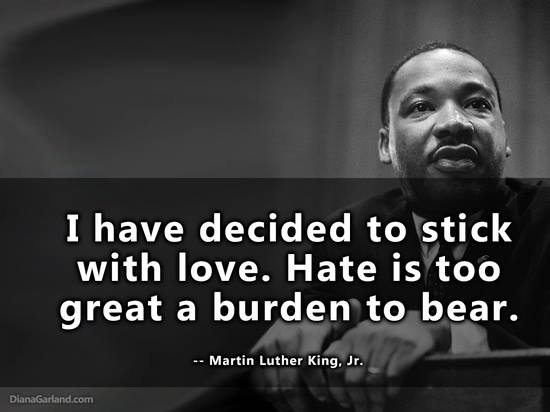
Agape by Rev. Dr. Martin Luther King, Jr.

MLK Choose Love


“The Greek language comes out with another word for love. It is the word agape. … agape is something of the understanding, creative, redemptive goodwill for all men. It is a love that seeks nothing in return. It is an overflowing love; it’s what theologians would call the love of God working in the lives of men. And when you rise to love on this level, you begin to love men, not because they are likeable, but because God loves them. You look at every man, and you love him because you know God loves him.” ―Martin Luther King Jr.

On Human Creeds and Such…

All creeds are human attempts to capture in human words the experience of the divine. The words we use to describe the divine will differ in every generation. There is no such thing as an unchanging universal language. No one can be bound by the words of a generation that no longer exists and that includes the words of our creeds. God is a living experience and talking about that experience will take different forms in every generation. None of those forms will ever be ultimate nor will any of them ever capture truth for all time. Words like infallible and inerrant have no place in the Christian vocabulary. – Bishop John Shelby Spong

A Lectio Divina for Today’s Christians by Richard Rohr

Read the following passage slowly and aloud four times. With the first reading, listen with your heart’s ear for a phrase or word that stands out for you. During the second reading, reflect on what touches you, perhaps speaking that response aloud or writing in a journal. Third, respond with a prayer or expression of what you have experienced and what it calls you to. Fourth, rest in silence after the reading.

The Shining Word “And”

“And” teaches us to say yes
“And” allows us to be both-and
“And” teaches us to be patient and long-suffering
“And” is willing to wait for insight and integration
“And” does not divide the field of the moment
“And” helps us to live in the always imperfect now
“And” keeps us inclusive and compassionate toward everything
“And” demands that our contemplation become action
“And” insists that our action is also contemplative
“And” is the mystery of paradox in all things
“And” is the way of mercy
“And” makes daily, practical love possible

Adapted from The Naked Now: Learning to See as the Mystics See,
pp. 180-181 – Fr. Richard Rohr

NOTE: “In ChristianityLectio Divina (Latin for divine reading) is a traditional Benedictinepractice of scriptural reading, meditation and prayer intended to promote communion with God and to increase the knowledge of God’s Word.[1] It does not treat Scripture as texts to be studied, but as the Living Word.” – Wikipedia


Only Love Can Handle the Truth – Richard Rohr

Fr. Rohr’s daily meditations play an important part in my faith formation – this one stands out among the rest.  A third way – standing in between – embracing the mystery that comes with being mere human.  There is no such thing as “real truth, real quick”.  This is what being a blessed fool is all about.

The contemplative mind does not need to prove anything or disprove anything. It’s what the Benedictines called a Lectio Divinaa reading of the Scripture that looks for wisdom instead of quick answers. It first says, “What does this text ask of me? How can I change because of this story?” And not “How can I use this to prove that I am right and others are wrong or sinful?”

The contemplative mind is willing to hear from a beginner’s mind, yet also learn from Scripture, Tradition—and others. It has the humility to move toward Yes/And thinking and not all-or-nothing thinking. It leads to a “Third Way,” which is neither fight nor flight, but standing in between—where I can hold what I do know together with what I don’t know. Holding such a creative tension with humility and patience leads us to wisdom instead of easy answers which largely create opinionated and smug people instead of wise people. We surely need wise people now, who hold their truth humbly and patiently.