Only Love Can Handle the Truth – Richard Rohr

Fr. Rohr’s daily meditations play an important part in my faith formation – this one stands out among the rest.  A third way – standing in between – embracing the mystery that comes with being mere human.  There is no such thing as “real truth, real quick”.  This is what being a blessed fool is all about.

The contemplative mind does not need to prove anything or disprove anything. It’s what the Benedictines called a Lectio Divinaa reading of the Scripture that looks for wisdom instead of quick answers. It first says, “What does this text ask of me? How can I change because of this story?” And not “How can I use this to prove that I am right and others are wrong or sinful?”

The contemplative mind is willing to hear from a beginner’s mind, yet also learn from Scripture, Tradition—and others. It has the humility to move toward Yes/And thinking and not all-or-nothing thinking. It leads to a “Third Way,” which is neither fight nor flight, but standing in between—where I can hold what I do know together with what I don’t know. Holding such a creative tension with humility and patience leads us to wisdom instead of easy answers which largely create opinionated and smug people instead of wise people. We surely need wise people now, who hold their truth humbly and patiently.
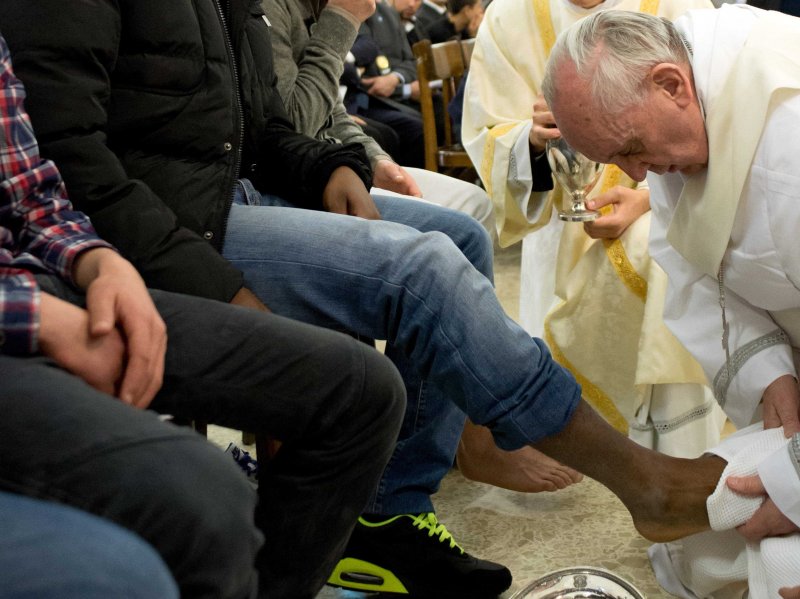
The Pope Just Published One of the Most Powerful Critiques of Modern Capitalism That You Will Ever Read – The Business Insider

ap783333958515-1

On the importance of remembering those who are less fortunate: “We can only praise the steps being taken to improve people’s welfare in areas such as health care, education and communications. At the same time we have to remember that the majority of our contemporaries are barely living from day to day, with dire consequences.”

On the seriousness of economic exclusion: “Just as the commandment ‘Thou shalt not kill’ sets a clear limit in order to safeguard the value of human life, today we also have to say ‘thou shalt not’ to an economy of exclusion and inequality. Such an economy kills.”

On the failure of traditional economic dogmas: “… some people continue to defend trickle-down theories which assume that economic growth, encouraged by a free market, will inevitably succeed in bringing about greater justice and inclusiveness in the world. This opinion, which has never been confirmed by the facts, expresses a crude and naïve trust in the goodness of those wielding economic power and in the sacralized workings of the prevailing economic system. Meanwhile, the excluded are still waiting.”

On exploding inequality: “While the earnings of a minority are growing exponentially, so too is the gap separating the majority from the prosperity enjoyed by those happy few.”

On the world’s obsession with money: “We have created new idols. The worship of the ancient golden calf (cf. Ex 32:1-35) has returned in a new and ruthless guise in the idolatry of money and the dictatorship of an impersonal economy lacking a truly human purpose.”

On the dangerous mix of inequality and consumerism: “It is evident that unbridled consumerism combined with inequality proves doubly damaging to the social fabric.”

On the role of the state in providing for the common good and regulating the economy: “This imbalance is the result of ideologies which defend the absolute autonomy of the marketplace and financial speculation. Consequently, they reject the right of states, charged with vigilance for the common good, to exercise any form of control. ”

Read more: http://www.businessinsider.com/the-pope-on-the-financial-system-inequality-money-2013-11#ixzz2n2AVmSKe

“What is the Bible?” – A Rob Bell Tumblr Series – The First of My Highlights

You start with the human. You ask those questions, you enter there, you direct your energies to understanding why these people wrote these books.

Because whatever divine you find in it, you find that divine through the human, not around it.

(I should play my hand here just a bit on where I want to take you: If you let go of the divine nature of the Bible on the front end and immerse yourself in the humanity of it, you find the divine in unexpected ways, ways that can actually transform your heart. Which is the point, right?)

Second, a bit about questions.

Often, especially when people come to a particular strange or gruesome or inexplicable passage, they’ll ask

Why did God say this?

The problem with this question is that it can leave you tied up in all kinds of knots. (Really? God told them to kill all the women and children? God did? And we’re supposed to accept that, well, that’s just how God is?)

That sort of thing.

The better question is:
Why did people find it important to tell this story?

Followed by
What was it that moved them to record these words?

Followed by
What was happening in the world at that time?

And then
What does this passage/story/poem/verse/book tell us about how people understood who they were and who God is at that time?

And then
What’s the story that’s unfolding here and why did these people think it was the story worth telling?

Read the series in full at: http://robbellcom.tumblr.com/

Christianity Divided by the Cross – Marcus Borg

American Christians are deeply divided by the cross of Jesus – namely, by how they see the meanings of his death. At the risk of labels and broad generalizations, “conservative” Christians generally believe a “payment” understanding of the cross: Jesus died to pay for our sins so we can be forgiven.

Most “progressive” Christians (at least a majority) have great difficulty with the “payment” understanding. Many reject it. Some insist that rather than focusing on Jesus’s death, we should instead focus on his life and teachings. They are right about what they affirm, even as they also risk impoverishing the meaning of Jesus by de-emphasizing the cross.

It is the central Christian symbol. And ubiquitous. Perhaps even the most widely-worn piece of jewelry. Its centrality goes back to the beginnings of Christianity. In one of the earliest New Testament documents, Paul in the early 50s summarized “the gospel” he had taught to his community in Corinth as “Christ crucified” (I Cor. 1-2). In the New Testament gospels beginning with Mark around 70, the story of Jesus’s final week and its climax in crucifixion and resurrection dominates their narratives. All four devote more than a fourth of their gospels to Jesus’s final week. And all anticipate the end of Jesus’s life earlier in their narratives. It is as if they are saying: you can’t tell the story of Jesus unless you tell the story of the cross.
Full blog post by Marcus Borg…
https://www.evernote.com/shard/s47/sh/9ce9c577-e24d-4f02-b1e7-60e98f0fdc8b/e146d70b7f9cc38c82fb54c223cd1220

“Languages are culturally constructed symbol systems” – Scot McKnight

From a theological perspective…fixation with propositions can easily lead to the attempt to use the finite tool of language on an absolute Presence that transcends and embraces all finite reality. Languages are culturally constructed symbol systems that enable humans to communicate by designating one finite reality in distinction from another. The truly infinite God of Christian faith is beyond all our linguistic grasping, as all the great theologians from Irenaeus to Calvin have insisted, and so the struggle to capture God in our finite propositional structures is nothing short of linguistic idolatry.