God Has No Grandchildren, Only Children – Richard Rohr

Jesus practically begs for some trust from his disciples, even after they’ve witnessed his miracles and heard his profound teaching. He eventually puts this question to them: “Who do you say that I am?” Don’t give me your theologies. Who is the Jesus you know? That’s the only Jesus that can really touch you and liberate you. Finally, Peter responds, “You are the Christ!” and Jesus gives him strict orders not to tell anyone (Mark 8:29-30). Why? Because each one of us has to walk the same journey of death and doubt for ourselves and come out the other side, enlarged by love.


No one can do this homework for us. Every generation has to be converted anew and the Gospel has to always be preached in new contexts and cultures in ways that are good news to that time and people. Yes, institutions and denominations are necessary and somehow inevitable, but when they imagine that they can prepackage the message in eternal formulas and half-believed (half-experienced?) doctrines and Scriptures, they often become their own worst enemy. Too many people join a club instead of going on a journey toward God, love, or truth.


+Adapted from The Four Gospels (Recording).

First Coming

He did not wait till the world was ready,
till men and nations were at peace
He came when the Heavens were unsteady
and prisoners cried out for release.

He did not wait for the perfect time.
He came when the need was deep and great.
He dined with sinners in all their grime,
turned water into wine.

He did not wait till hearts were pure.
In joy he came to a tarnished world
of sin and doubt. To a world like ours,
of anguished shame He came, and
his Light would not go out. 

He came to a world which did not mesh,
to heal it’s tangles, shield its scorn.
In the mystery of the Word made Flesh
the Maker of the stars was born.

We cannot wait till the world is sane
to raise our songs with joyful voice,
for to share our grief, to touch our pain,
He came with Love: Rejoice! Rejoice!

by Madeleine L’Engle
Christmas star of the Nativity of Bethlehem, Nativity of Jesus Christ. Background of the beautiful dark blue starry sky and bright star.

GOD IS NOT SANTA CLAUS – Richard Rohr

If we want to go to the mature, mystical, and non-dual levels of spirituality, we must first deal with the often faulty, inadequate, and even toxic images of God with which most people are dealing before they have authentic God Experience. Both God as Trinity and Jesus as the image of the invisible God reveal a God quite different than the Santa Claus god who made “naughty and nice” lists or an “I will torture you if you do not love me” god (worse than our worst enemy, I would think). We must be honest and admit that this is the god to which most people are still praying. Such images are an unworkable basis for any real spirituality.
Trinity reveals that God is the Divine Flow under, around, and through all things much more a verb than a noun, relationship itself rather than an old man sitting on a throne. Jesus tells us that God is like a loving par ent who runs toward us while we are “still a long way off” (Luke 15:20), then clasps and kisses us. Until this is personally experienced, most of Christianity does not work. This theme moves us quickly into practice based religion (orthopraxy) over mere words and ideas (orthodoxy).

Trusting Our Inner Experience

Father Richard Rohr elaborates on Carl Jung’s teaching on the importance of inner experience as the only pathway to transformation.

Carl Jung wanted to bring externalized religion back to its internal foundations. He saw how religion kept emphasizing the unbridgeable distance between the Creator and creation, God and humanity, inner and outer, the one and the many. In spite of creation’s ecological unity (Genesis 1:9–31), Christianity too often began by emphasizing the problem of separation (“original sin”) instead of beginning with the wonderful unity between creation and Creator.

Except for the experience of many saints and mystics, religion has greatly underemphasized any internal, natural resonance between humans and God. This gives us clergy an almost impossible job! First, we must remind everyone that they are “intrinsically disordered” or sinful—which then allows us to just happen to have the perfect solution. It is like a vacuum cleaner seller first pouring dirt on the floor to show how well this model works. As if the meaning of this beautiful universe could start with a foundational problem!

Christianity rarely emphasized the plausibility or power of inner spiritual experience. Catholics were told to believe the pope, the bishops, and the priests. Protestants were told to believe the Bible. The Catholic version has fallen apart with the pedophilia crisis worldwide; Protestantism’s total reliance on preaching the Bible has been undone by postmodern worldviews. But both Catholics and Protestants made the same initial mistake, I’m sorry to say. It’s all about trusting something outside of ourselves. We gave people answers that were extrinsic to the soul and dismissed anything known from the inside out. “Holiness” largely became a matter of intellect and will, instead of a deep inner trust with an inner dialogue of Love. It made us think that the one with the most willpower wins, and the one who understands things the best is the beloved of God—the opposite of most biblical heroes. We’ve been gazing at our own “performance” instead of searching for the Divine in us and in all things. 

We must begin with a foundational “yes” to who we are and to what is (Reality). This is mature religion’s primary function. It creates the bedrock foundation for all effective faith. If we begin with a problem, the whole journey remains largely a negative problem-solving exercise that never ends. We’re left with inherently argumentative and competitive Christianity.

If we begin with the positive, and get the issue of core identity absolutely clear, the rest of the journey—even though it isn’t always easy—is by far more natural, more beautiful, more joyful and all-inclusive. What else should the spiritual journey be? When we start in the basement, most people never believe they can even get to the first floor, and they just opt out. Isn’t this obvious at this point in Christian history? Sadly, we clergy became angry guards instead of joyful guides, policing dogma instead of proclaiming the Great Gift which is perfectly hidden and perfectly revealed at the heart of all creation from the very beginning.

Universal Love

Love [people] even in [their] sin, for that is the semblance of Divine Love and is the highest love on earth. Love all God’s creation, the whole  and every grain of sand in it. Love every leaf, every ray of God’s light. Love the animals, love the plants, love everything. If you love everything, you will perceive the divine mystery in things. Once you have perceived it, you will begin to comprehend it better every day. And you will come at last to love the whole world with an all-embracing love. —Fyodor Dostoyevsky

God restores rather than punishes, which is a much higher notion of how things are “justified” before God. The full and final Biblical message is restorative justice, but most of history has only been able to understand retributive justice. Now, I know you’re probably thinking of many passages in the Old Testament that sure sound like serious retribution. And I can’t deny there are numerous black and white, vengeful scriptures, which is precisely why we must recognize that all scriptures are not equally inspired or from the same level of consciousness.

Please take a moment to read Father Rohr’s full meditation.

The meditation concludes with these powerful words…

As long as your ego is in charge, you will demand a retributive God; you’ll insist that hell is necessary. But if you have been transformed by love, hell will no longer make sense to you because you know that God has always loved you in your sinfulness. Why would God change policies after death?  

We are all saved by mercy and grace without exception—before, during, and after our life in this world. Could God’s love really be that great and universal? Love is the lesson, and God’s love is so great that God will finally teach it to all of us. Who would be able to resist it once they see it? We’ll finally surrender, and God—Love—will finally win. God never loses. That is what it means to be God. That will be God’s “justice,” which will swallow up our lesser versions of retributive justice.

– Fr. Richard Rohr


1 Corinthians 13: 4-8 – Paraphrased by Brother Joseph Schmidt

If I live my life to perfection, doing what is right and good on behalf of others, but act with compulsion and without love, then I am nothing at all. 

If I take care of the needs of everybody in the world, especially the poor, because of my own need to help, but am without love even for myself, then I am nothing at all.

If I am efficient and successful in all that I do for the sake of justice, but act out of drivenness and without love, then I am nothing at all.

If I am cultured and refined, and in touch with the pain of existence, but am absent from the pain of persons in the present moment who need my empathy; and if I act without love and compassion, then I am nothing at all.

If I have the gifts of wisdom, insight, and understanding, but am not engaged with those around me in the present moment and am without a spirit of compassion and love, then I am nothing at all.

If I am faithful, loyal, and obedient, and never deviate from the law, but am judgmental and blaming, and am without love, then I am nothing at all.

If I live in a pain-free world of dreams and plans, enjoying optimism and pleasurable options, but am not addressing present problems and am avoiding people in actual distress and am without love, then I am nothing at all.

If I am strong and powerful, but lose my best self in a spirit of resentment, retaliation, and vindictiveness, and know nothing of the vulnerability of love, then I am nothing at all.

If I am settled and accommodating, holding onto a sense of distance and calm, but am not journeying inward to know and appreciate my weaknesses and gifts, and am neglecting my own legitimate calling to love myself, then I am nothing at all.

Love is always patient and kind;

it is never jealous;

love is never boastful or conceited;

it is never rude or selfish;

it does not take offense, and is not resentful.

Love takes no pleasure in other people’s sins but delights in truth;

it is always ready to excuse, to trust, to hope, and to endure whatever comes.

Love never fails, never ceases.

What is the Bible? Part 54: Predestination, Election, and that Burning Feeling in the Pit of Your Soul

Rob-Bell

A favorite excerpt from Rob Bell’s Tumblr blog series entitled – What is the Bible?  Spoiler alert the passage below is at the end of his post – so if you would like to start first at the top click here.

Always ask yourself when you come across something that religious people have been debating and discussing for years what would happen if you actually had concrete answers to the questions. 

When I have been asked whether some are chosen or not, I always ask How would you ever know such a thing? and more importantly How would that ever make your life better? 

Some things that religious people make a big deal of are rather pointless. Avoid the insanity.

How often do you ask What would it feel like to swallow a hair dryer while it was turned on? 

No, you don’t, because it’s not interesting. And if you could answer the question, what would you have gained?

Here then is my word to you: Don’t participate in discussions that are pointless. You can say yes to God’s love and grace today, you can be grateful for each and every breath, you can trust that there is meaningful work for you to do today in the world. You can heal, you can be free, you can become more and more courageous and full of joy. All of this can be more and more the dominant reality of your life as you become more and more the person Jesus insists you can be. Why would you spend time on topics and discussions that have nothing to do with the very real invitation every single one of us have right now to live life to the fullest?

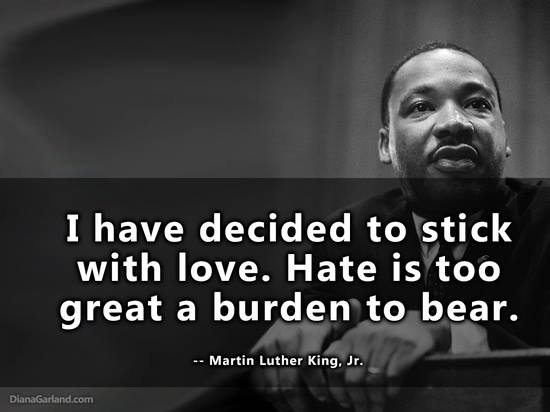
Agape by Rev. Dr. Martin Luther King, Jr.

MLK Choose Love


“The Greek language comes out with another word for love. It is the word agape. … agape is something of the understanding, creative, redemptive goodwill for all men. It is a love that seeks nothing in return. It is an overflowing love; it’s what theologians would call the love of God working in the lives of men. And when you rise to love on this level, you begin to love men, not because they are likeable, but because God loves them. You look at every man, and you love him because you know God loves him.” ―Martin Luther King Jr.

“Loving Your Enemies” – Dr. Martin Luther King

397529_322702437848158_797797404_n

“Loving Your Enemies.” It’s so basic to me because it is a part of my basic philosophical and theological orientation: the whole idea of love, the whole philosophy of love. In the fifth chapter of the gospel as recorded by Saint Matthew, we read these very arresting words, flowing from the lips of our Lord and Master: ‘Ye have heard that it has been said, ‘Thou shall love thy neighbor, and hate thine enemy.’ But I say unto you, love your enemies, bless them that curse you, do good to them that hate you, and pray for them that despitefully use you, that ye may be the children of your Father which is in heaven.”

And if you go to Washington, you will discover that one of the greatest words or statements ever made about Abraham Lincoln was made by this man Stanton. And as Abraham Lincoln came to the end of his life, Stanton stood up and said, “Now he belongs to the ages.” He made a beautiful statement concerning the character and the stature of this man. If Abraham Lincoln had hated Stanton, if Abraham Lincoln had answered everything Stanton said, Abraham Lincoln would have not transformed and redeemed Stanton. Stanton would have gone to his grave hating Lincoln, and Lincoln would have gone to his grave hating Stanton. But through the power of love, Abraham Lincoln was able to redeem Stanton. That’s it. There is a power in love that our world has not discovered yet. Jesus discovered it centuries ago. Mahatma Gandhi of India discovered it a few years ago, but most men and most women never discover it. For they believe in hitting for hitting; they believe in an eye for an eye, and a tooth for a tooth; they believe in hating for hating. But Jesus comes to us and says, “This isn’t the way.”

It seems to me that this is the only way. As our eyes look to the future, as we look out across the years and across the generations, let us develop and move right here. We must discover the power of love, the power, the redemptive power of love. And when we discover that, we will be able to make of this old world a new world. We will be able to make men better. Love is the only way. Jesus discovered that.

Not only did Jesus discover it, even great military leaders discover that. One day as Napoleon came toward the end of his career and looked back across the years, the great Napoleon that at a very early age had all but conquered the world. He was not stopped until he became, till he moved out to the battle of Leipzig and then to Waterloo. But that same Napoleon one day stood back and looked across the years, and said: “Alexander, Caesar, Charlemagne, and I have built great empires, but upon what did they depend? They depended upon force. But long ago, Jesus started an empire that depended on love, and even to this day millions will die for him.”

Yes, I can see Jesus walking around the hills and the valleys of Palestine.  And I can see him looking out at the Roman Empire with all of her fascinating and intricate military machinery. But in the midst of that, I can hear him saying: “I will not use this method. Neither will I hate the Roman Empire.”

So this morning, as I look into your eyes, and into the eyes of all of my brothers in Alabama and all over America and over the world, I say to you, “I love you. I would rather die than hate you.”  And I am foolish enough to believe that through the power of this love somewhere men of the most recalcitrant bent will be transformed. And then we will be in God’s kingdom. We will be able to matriculate into the university of eternal life because we had the power to love our enemies, to bless those persons that cursed us, to even decide to be good to those persons who hated us, and we even prayed for those persons who despitefully used us.

…Full Sermon Transcript – https://www.evernote.com/shard/s47/sh/2dcfe7de-b8cf-4444-aba0-83d397344be3/00d772a2afb5f5323dec63faadf837d5