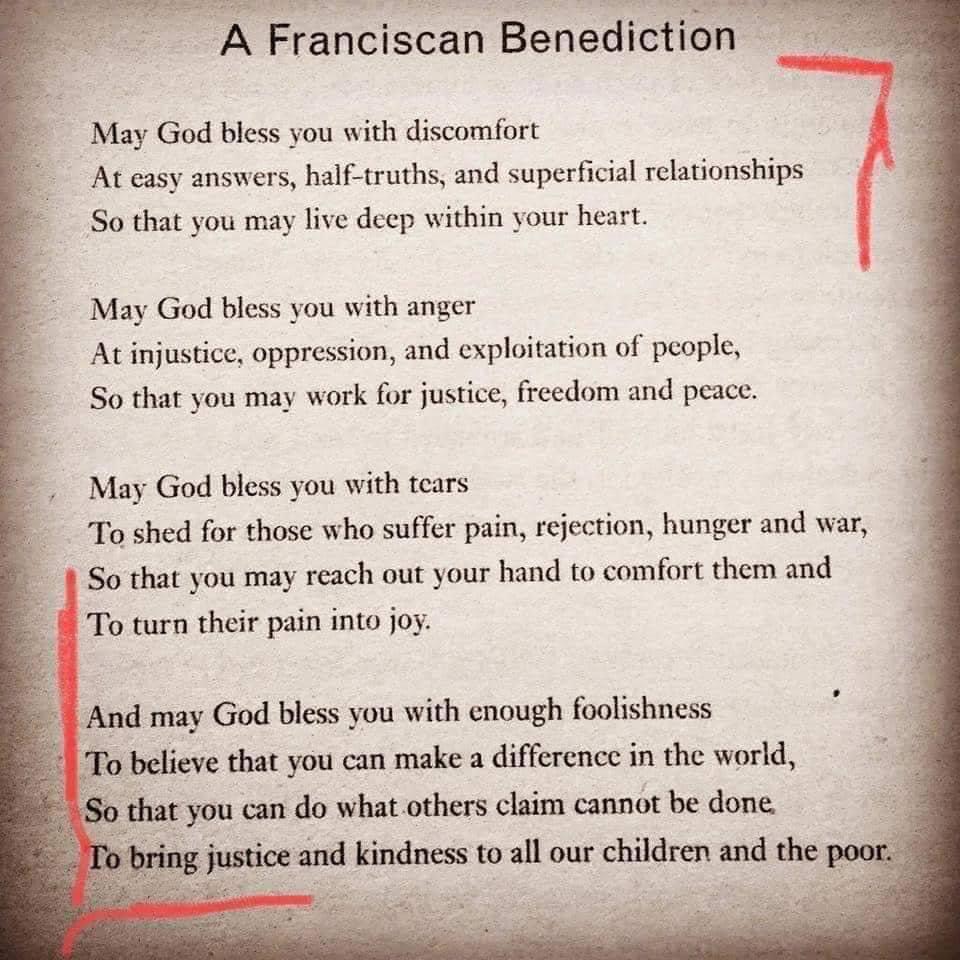
A Franciscan Benediction

Arab-American poet Naomi Shihab Nye recalls a transformative, unexpected occasion of generous acceptance:
Wandering around the Albuquerque Airport Terminal … I heard an announcement: “If anyone in the vicinity of Gate A-4 understands any Arabic, please come to the gate immediately.”
Well—one pauses these days. Gate A-4 was my own gate. I went there.
An older woman in full traditional Palestinian embroidered dress, just like my grandma wore, was crumpled to the floor, wailing loudly. “Help,” said the flight service person. “Talk to her.… We told her the flight was going to be late and she did this.”
I stooped to put my arm around the woman and spoke to her haltingly. “Shu-dow-a, Shu-bid-uck Habibti? Stani Schway, Min fadlick, Shu-bit-se-wee?” The minute she heard any words she knew, however poorly used, she stopped crying. She thought the flight had been canceled entirely. She needed to be in El Paso for major medical treatment.… I said, “No, we’re fine, you’ll get there, just later, who is picking you up? Let’s call him.”
We called her son and I spoke with him in English. I told him I would stay with his mother … and would ride next to her.… She talked to him. Then we called her other sons just for the fun of it. Then we called my dad and he and she spoke for a while in Arabic and found out of course they had ten shared friends. Then I thought … why not call some Palestinian poets I know and let them chat with her? This all took up about two hours.
She was laughing a lot by then. Telling about her life, patting my knee, answering questions. She had pulled a sack of homemade mamool cookies—little powdered sugar crumbly mounds stuffed with dates and nuts—out of her bag—and was offering them to all the women at the gate. To my amazement, not a single woman declined one. It was like a sacrament. The traveler from Argentina, the mom from California, the lovely woman from Laredo—we were all covered with the same powdered sugar. And smiling. There is no better cookie.
And then the airline broke out free beverages … and two little girls from our flight ran around serving us all apple juice and they were covered with powdered sugar, too. And I noticed my new best friend—by now we were holding hands—had a potted plant poking out of her bag, some medicinal thing, with green furry leaves. Such an old country traveling tradition. Always carry a plant. Always stay rooted to somewhere.
And I looked around that gate of late and weary ones and thought, this is the world I want to live in. The shared world. Not a single person in that gate—once the crying of confusion stopped—seemed apprehensive about any other person. They took the cookies. I wanted to hug all those other women, too. This can still happen anywhere. Not everything is lost.
Naomi Shihab Nye, “Gate A-4,” in Honeybee: Poems & Short Prose (New York: Greenwillow Books, 2008), 162–164.
Shared via https://cac.org/daily-meditations/ – Center for Action and Contemplation
The great chain of being was the medieval metaphor for ecology before we spoke of ecosystems. While it was structured as a hierarchy, with each link in the chain “closer” to God, I view it as a philosophical and theological attempt to speak of the interconnectedness of all things on the level of pure “Being.” Today we might call it “the circle of life.” If God is Being Itself (Deus est Ens), as both St. Bonaventure and St. Thomas Aquinas taught in the thirteenth century, then the great chain became a way of teaching and preserving the inherent dignity of all things that participate in that Divine Being in various ways. For me, it speaks of the inherent sacrality, interconnectedness, and communality of creation.
These are the links in the great chain of being:
Link 1: The firmament/Earth/minerals within the Earth
Link 2: The waters upon the Earth (snow, ice, water, steam, mist)
Link 3: The plants, trees, flowers, and foods that grow upon the Earth
Link 4: The animals on the Earth, in the skies, and in the seas
Link 5: The human species, capable of reflecting on the other links
Link 6: The heavenly realm/Communion of Saints/angels and spirits
Link 7: God/the Divine Realm/the Mystery that creates a universe as such, which needs a Center, Source, and Ground for any coherence.
Such a graphic metaphor held all things together in an enchanted universe. If we could not see the sacred in nature and creatures, we soon could not see it at all. [1]
As the medieval theologians predicted, once the chain was broken and one link not honored, the whole vision collapsed. Either we acknowledge that God is in all things, or we have lost the basis for seeing God in anything. Once the choice is ours and not God’s, it is merely a world of private preferences and prejudices. The “cosmic egg” is shattered.
Bonaventure (c. 1217–1274), who is called the second founder of the Franciscan Order, took Francis’ intuitive genius and spelled it out into an entire philosophy. “The magnitude of things … clearly manifests the immensity of the power, wisdom, and goodness of the triune God, who by his power, presence, and essence exists uncircumscribed in all things.” [2] Bonaventure expanded on Alan of Lille’s philosophical idea of God as one “whose center is everywhere and whose circumference is nowhere.” God is “within all things but not enclosed; outside all things, but not excluded; above all things, but not aloof; below all things, but not debased.” [3] Therefore the origin, magnitude, multitude, beauty, fullness, activity, and order of all created things are the very “footprints” and “fingerprints” (vestigia) of God. [4]
[1] Adapted from Richard Rohr, insert in A New Cosmology: Nature as the First Bible (Albuquerque, NM: Center for Action and Contemplation, 2009). Available as MP3 audio download.
[2] Bonaventure, The Soul’s Journey into God 1.14, trans. Ewert Cousins (New York: Paulist Press, 1978), 65.
[3] Bonaventure, Soul’s Journey 5.8; Cousins, 100–101.
[4] Adapted from Richard Rohr, The Wisdom Pattern: Order, Disorder, Reorder (Cincinnati, OH: Franciscan Media, 2001, 2020), 149–150.
Almost all religions and cultures that I know of have believed in one way or another that sin and evil are to be punished and retribution is to be demanded of the sinner in this world—and usually the next world, too. Such retributive justice is a dualistic system of reward and punishment, good folks and bad folks, and makes perfect sense to the ego. I call it the economy of merit or “meritocracy.” This system seems to be the best that prisons, courtrooms, wars, and even most of the church (which should know better) appear equipped to do.
Jesus, many mystics, and other wisdom traditions—such as the Twelve Steps of Alcoholics Anonymous—show that sin and failure are, in fact, an opportunity for the transformation and enlightenment of the offender.
Mere counting and ledger-keeping are not the way of the Gospel. Our best self wants to restore relationships, and not blame or punish. This is the “economy of grace.” (The trouble is that we defined God as “punisher-in-chief” instead of Healer, Forgiver, and Reconciler and so the retribution model was legitimized all the way down!)
What humanity really needs is an honest exposure of the truth and accountability for what has happened. Only then can human beings move ahead with dignity. Hurt needs to be spoken and heard. It does not just go away on its own. This can then lead to “restorative justice,” which is what the prophets invariably promise to the people of Israel (see Ezekiel 16:53; Isaiah 57:17–19) and is exemplified in Jesus’ story of the Prodigal Son (Luke 15:11–32) and throughout his healing ministry. We lose that and we lose the Gospel itself.
As any good therapist knows, we cannot heal what we do not acknowledge. What we do not consciously acknowledge will remain in control from within, festering and destroying us and those around us. In the Gospel of Thomas, Jesus teaches, “If you bring forth that which is within you, it will save you. If you do not bring it forth, it will destroy you.” [1]
Only mutual apology, healing, and forgiveness offer a sustainable future for humanity. Otherwise, we are controlled by the past, individually and corporately. We all need to apologize and we all need to forgive or this human project will surely self-destruct. No wonder almost two-thirds of Jesus’ teaching is directly or indirectly about forgiveness. Otherwise, history devolves into taking sides, bitterness, holding grudges, and the violence that inevitably follows. As others have said, “Forgiveness is to let go of our hope for a different past.” Reality is what it is, and such acceptance leads to great freedom, as long as there is also both accountability and healing forgiveness.
[1] Gospel of Thomas, saying 70. For other translations of the Gospel of Thomas and links to additional resources, see http://www.gnosis.org/naghamm/nhl_thomas.htm
Adapted from Richard Rohr, Breathing under Water: Spirituality and the Twelve Steps 10th anniv. ed. (Cincinnati, OH: Franciscan Media, 2011, 2021), 37–38, 45–46.
The sin warned against at the very beginning of the Bible is “to eat of the tree of the knowledge of good and evil” (Genesis 2:17). It does not sound like that should be a sin at all, does it? But the moment I sit on my throne, where I know with certitude who the good guys and the bad guys are, then I’m capable of great evil—while not thinking of it as evil! I have eaten of a dangerous tree, according to the Bible. Don’t judge, don’t label, don’t rush to judgment. You don’t usually know other people’s real motives or intentions. You hardly know your own.
The author of the classic book The Cloud of Unknowing says that first, you have to enter into “the cloud of forgetting. Forget all your certitudes, all your labels, all your explanations, whereby you’ve put this person in this box, determined this group is going to heaven, decided this race is superior to that race. Just forget it. It’s largely a waste of time. It’s usually your ego projecting itself, announcing itself, and protecting itself. It has little to do with objective reality or real love of the truth. If the world and the world’s religions do not learn this kind of humility and patience very soon, I think we’re in historical trouble.
+Adapted from Beginner’s Mind (Recording).
Those at the edge of any system and those excluded from any system ironically and invariably hold the secret for the conversion and wholeness of that very group. They always hold the feared, rejected, and denied parts of the group’s soul. We see, therefore, why the church was meant to be that group that constantly went to the edges, to the least of the brothers and sisters, and even to the enemy. Jesus was not just a theological genius; he was also a psychological and sociological genius. Therefore, when any church defines itself by exclusion of anybody, it is always wrong. It is avoiding its only vocation, which is to be the Christ. The only groups that Jesus seriously critiques are those who include themselves and exclude others from the always-given grace of God.
Only as the People of God receive the stranger, the sinner, and the immi-grant, those who don’t play our game our way, do we discover not only the hidden, feared, and hated parts of our own souls, but also the fullness of Jesus himself. We need them for our own conversion.
The church is always converted when the outcasts are re-invited back into the temple. We see this in Jesus’s common action of sending marginalized people that he has healed back into the village, back to their family, or back to the Temple to show themselves to the priests. It is not just for their re-inclusion and acceptance, but actually for the group itself to be renewed.
+ Adapted from Radical Grace: Daily Meditations, p. 28.
Whenever the human and the divine coexist, at the same time, in the same person, you have Christianity. I don’t know that it finally matters what Scriptures you read, liturgies you attend, or moral positions you hold about this or that, as much as it is how you live trustfully inside of God’s one world. This creates honest people, people who don’t waste time proving they’re right, superior, or saved. They just try to live and love the daily mystery that they are in the loving presence of God. “God comes to you disguised as your life,” as Paula D’Arcy proclaimed the first time we taught together. Imagine that!
There are basically four worldviews: (1) reality is just matter, (2) reality is just spirit, (3) through religion and morality, you can work to put matter and spirit together (the most common religious position), and (4) the material world has always been the place where Spirit is revealed. You cannot put them together–they already are together, as in Jesus. Only the fourth position, incarnationalism, deserves to be called authentic Christianity. It has little to do with the right rituals, only the right reality.
+ Adapted from Great Themes of Paul: Life as Participation (Recording).
This is one good thing that silence and waiting have taught me: Our lives are always useable by God. We need not always be effective, but only transparent and vulnerable. Then we are instruments, no matter what we do.
Silence is the ability to trust that God is acting, teaching, and using us-even before we perform or after our seeming failures. Silence is the necessary space around things that allows them to develop and flourish without our pushing.
God takes it from there, and there is not much point in comparing who is better, right, higher, lower, or supposedly saved. We are all partial images, slowly coming into focus, as long as we allow and filter the Light and Love of God, which longs to shine through us-as us!
+Adapted from Contemplation in Action, p. 134. By Richard Rohr
“You have been told, O mortal, what is good and what YHWH requires of you: to do justice, to love mercy, and to walk humbly with your God.” —Micah 6:8
Scholar and retreat leader Megan McKenna deepens our understanding of God’s desire for us through the prophet Micah. For McKenna, Micah’s simple and challenging verse reveals the essence of what the prophets are about:
According to God, this is life. This is the call of the prophets in a nutshell, the meat at the heart of their very existence. The words used are significant: “Do justice”—the Hebrew word mishpat means more than specific acts of justice. It defines God’s order in the world; it is the covenant guide for living in community; and it is the memory of God’s words and deeds past and present and the people’s response in gratitude toward one another. In a word it says, Be the Torah; do God’s justice; imitate God in your life.…
“Do justice” means to be faithful as God is faithful, holy as God is holy, to set those in bondage free, to hear compassionately the cries of those in slavery, to do for one’s neighbor what God has so graciously done for you. It is the teaching of the Torah, the source of abundant life. These two words—Do justice—point to the way of God and simply say: walk in it! Whatever the concept of justice might be, it is only by doing acts of justice, by solidly standing with those in need of justice, and by resisting injustice that justice can become a reality.
The second demand is “Love mercy” (or “Love tenderly”). The Hebrew word hesed, compassion, means coming to the rescue of the poor, the outcast, the alien, the slave, the powerless, hearing the cries of those in misery, giving love that is faithful, sustaining, enduring. It is the way God loves [God’s] people, and God’s people are to return that love by loving one another. This urgent command shoots right to the heart of every individual and to the community. [1]
Howard Thurman (1899–1981) asks what it means to walk humbly with God, the third of God’s requirements to Micah:
How do you walk humbly with God? How do you? How do you walk humbly with anybody?… [By] coming to grips with who I am, what I am as accurately and as fully as possible: a clear-eyed appraisal of myself. And in the light of the dignity of my own sense of being I walk with God step by step as [God] walks with me. This is I, with my weaknesses and my strength, with my abilities and my liabilities; this is I, a human being myself! And it is that that God salutes. So that the more I walk with God and God walks with me, the more I come into the full-orbed significance of who I am and what I am. That is to walk humbly with God. [2]
[1] Megan McKenna, Prophets: Words of Fire (Maryknoll, NY: Orbis Books, 2001), 129–130.
[2] Howard Thurman, “The Message of Micah,” August 17, 1952, in Moral Struggle and the Prophets, ed. Peter Eisenstadt and Walter Earl Fluker (Maryknoll, NY: Orbis Books, 2020), 196–197. Note: minor edits made for inclusive language.
The great thing about God’s love is that it’s not determined by the object.
God does not love us because we are good. God loves us because God is good.
It takes our whole lives for that to sink in, along with lots of trials and testing of divine love, because that’s not how human love operates.
Human love is largely determined by the attractiveness of the object.
When someone is nice, good, not high-maintenance, physically attractive, important, or has a nice personality, we find it much easier to give ourselves to them or to “like” them. That’s just the way we humans operate.
We naturally live in what I call the meritocracy of quid pro quo. We must be taught by God and grace how to live in an economy of grace. Divine love is a love that operates in a quite unqualified way, without making distinctions between persons and seemingly without such a thing as personal preference. Anyone who receives divine love feels like God’s favorite in that moment! We don’t even have the capacity to imagine such a notion until we have received it! Divine love is received by surrender instead of any performance principle whatsoever.
+Adapted from Following the Mystics through the Narrow Gate…
Seeing God in All Things (Recording).

