Whenever the human and the divine coexist, at the same time, in the same person, you have Christianity. I don’t know that it finally matters what Scriptures you read, liturgies you attend, or moral positions you hold about this or that, as much as it is how you live trustfully inside of God’s one world. This creates honest people, people who don’t waste time proving they’re right, superior, or saved. They just try to live and love the daily mystery that they are in the loving presence of God. “God comes to you disguised as your life,” as Paula D’Arcy proclaimed the first time we taught together. Imagine that!
There are basically four worldviews: (1) reality is just matter, (2) reality is just spirit, (3) through religion and morality, you can work to put matter and spirit together (the most common religious position), and (4) the material world has always been the place where Spirit is revealed. You cannot put them together–they already are together, as in Jesus. Only the fourth position, incarnationalism, deserves to be called authentic Christianity. It has little to do with the right rituals, only the right reality.
+ Adapted from Great Themes of Paul: Life as Participation (Recording).
One reason so many theologians are interested in the Trinity now is that we’re finding both physics (especially quantum physics) and cosmology are at a level of development where those sciences in general our understanding of the atom and our understanding of galaxies – are affirming and confirming our use of the old Trinitarian language, but with a whole new level of appreciation. Reality is radically relational, and all the power is in the relationships themselves – not in the particles or the planets, but in the space in between the particles and planets. It sounds a lot like what we called the Holy Spirit.
No good Christians would have denied the Trinitarian Mystery, but, until our generation, none were prepared to see that the shape of God is the shape of the whole universe!
Great science, which we once considered an enemy of religion, is now helping us see that we are standing in the middle of awesome Mystery, and the only response before that Mystery is immense humility. Astrophysicists are much more comfortable with emptiness and non-explainability (dark matter, black holes), and living with hypotheses than most Christians I know. Who could have imagined this?
+ Adapted from The Shape of God: Deepening the Mystery of the Trinity
In the Risen Christ, God reveals the final state of all reality. God forbids us to accept as it is in favor of what God’s love can make it. To believe in resurrection means to cross limits and transcend boundaries. Because of the promise of the resurrection of Jesus, we realistically can believe that tomorrow can be better than today. We are not bound by any past. There is a future that is created by God and much bigger than our own efforts.We should not just believe in some kind of survival or immortality or just”Life after death” but resurrection, an utterly new creation, a transformation into Love that is promised as something that can happen in this world and is God’s final chapter for all of history. That is why a true Christian must be an optimist. In fact, if you are not an optimist, you haven’t got it yet.
+ Adapted from Radical Grace: Daily Meditations, p. 150.
The True Sacred, which is what you are seeking in prayer and silence, always reveals that:
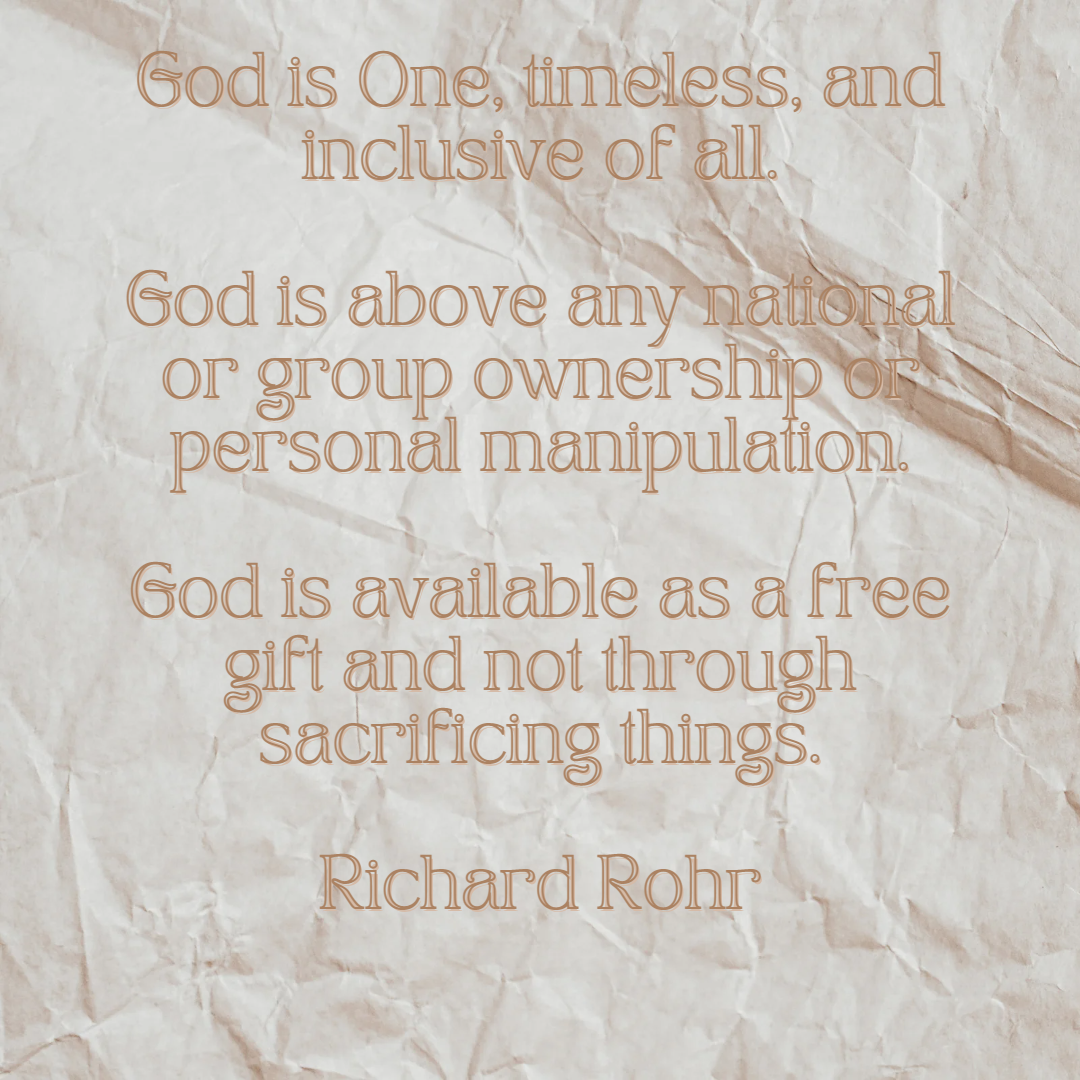
God is above any national or group ownership or personal manipulation.
God is available as a free gift and not through sacrificing things.
God needs no victims and creates no victims. Jesus ends religion as sacrifice “once and for all’ by revealing the tragic effects of scapegoating through what happened to him on the cross (Hebrews 7:27, 10:10).
Jesus personifies this type of God and speaks defiantly in defense of such a God. Nowhere is he more succinct than when he quotes the prophet Hosea, “Go and learn the meaning of the words: ‘Mercy is what pleases me, not sacrifices” (Matthew 9:13).
+Adapted from Jesus’ Plan for a New World: The Sermon on the Mount, p. 5.
Our image of God, our de facto, operative image of God, lives in a symbiotic relationship with our soul and creates what we become. Loving and forgiving people have always encountered a loving and forgiving God. Cynical people are cynical about the very possibility of any coherent or loving Center to the universe, so why wouldn’t they become cynical themselves?
When we encounter a truly sacred text, the first questions are often, “Did this literally happen just as it states? How can I be saved? What is the right thing for me to do? What is the dogmatic pronouncement here? Does my church agree with this? Who is right and who is wrong here?” These are largely ego questions. They are the questions we were trained to ask, because everybody else asks them, unfortunately! They are questions that try to secure our position, not questions that help us go on a spiritual path of faith and trust. They constrict us, whereas the purpose of the Sacred is to expand us.
Having read a sacred text, I would invite you to ponder these questions:
1. What is God doing here?
2. What does this say about who God is?
3. What does this say about how I can then relate to such a God?
+Adapted from A Teaching on Wondrous Encounters (Recording).
God’s revelations are always pointed, concrete, and specific. They come not from a Platonic world of ideas and theories about which we can be right or wrong or observe from a distance. Divine Revelation is not something we measure or critique. It is not an ideology, but a Presence we intuit and meet! It is more Someone than something.
All of this is called the “mystery of incarnation”-enfleshment or embodiment, if you prefer and for Christians it reaches its fullness in the incarnation of God in one ordinary looking man named Jesus. God materialized in human form so we could fall in love with a real person, which is the only way we fall in love at all. Walter Brueggemann called this clear Biblical pattern “the scandal of the particular.” We first get the truth in one specific, ordinary place and moment (like the one man, Jesus), and then we universalize from that to the universal truth (the cosmic Christ). Our Franciscan philosopher John Duns Scotus called this the principle of “thisness” (haecceity or haecceitas in Latin). We can only know in focused moments what is always and everywhere true.
+Adapted from Things Hidden: Scripture as Spirituality, p. 17.
BB: So, this leads me to another quote, which I think is something that I really… You know we have those internal conflicts, and I couldn’t name it until now. But I have Brené, who’s seven, at Holy Name of Jesus Elementary School and Sister DaVita. And I was scared to death. And then I have the adult in her 50s Brené saying, “It’s okay. God… If this makes us connect… Closer connected to God, we can change these words.” And there’s an internal struggle sometimes. But when I think about this quote of yours all the time, “God is always bigger than the boxes we build for God, so we should not waste too much time protecting the boxes.”
RR: The boxes. That’s the job of a clergyman. He thinks. She thinks, I guess. Yeah. God has to obey our laws. I mean let’s take the whole gay issue. How dare we say to God, in effect, “You may not love gay people. You’re not allowed to, God. We have decided.” And that’s what we’re saying because…
BB: Wow.
RR: We can’t deal with infinity. The human mind can’t form the notion of infinity. So, as all the mystics say, “God is infinite love.” Infinite. We don’t know how to process that. We just don’t. So we pull God down and make an anthropomorphism out of God so he loves like we do, very conditionally, with threats and punishments.
BB: And ego.
RR: Yeah, and ego.
BB: We create a God that loves with ego, which is like the opposite of God.
RR: Oh, you get it. Why didn’t we meet 30 years ago? Darn. When did you start going on the road?
BB: 15 years ago, maybe.
RR: I see. See I was on for 52.
BB: Wow.
RR: That’s why my voice is almost gone now. Go ahead.
BB: When you say… Like, I’m thinking about all the anti-trans bills right now that are really dehumanizing trans kids, especially targeting trans kids.
RR: Yes.
BB: And when you say when you do that, you’re telling God who God can love and who God shouldn’t love.
RR: You are not allowed to love this person.
BB: Oh that is…
RR: We’re back in charge. We’re back in charge. Yeah. Well, you get it, thank you. Thank you.
BB: Well that feels me with grief.
RR: Grief, I know. Imagine the pain we’ve caused so many people at so many levels, who until the recent generation lived lives of pretend, disguise, denial.
BB: A mask.
RR: A mask, when all God wants us to be is who we really are.
BB: So, flawed and imperfect.
RR: Created in the image of God, that’s right. Which always there is a fly in the ointment, and it’s a struggle with that fly, that gets religion on the bad course when you can’t integrate failure, the negative sin, mistake, that’s the work of vulnerability.
BB: Is there a prayerful contemplative way to find our way to an understanding of infinity but to find our way? Do you know what I’m asking? Like… I don’t want an answer, but is there a path to get us closer?
RR: The historic universal paths of spiritual transformation are two, great love and great suffering. Now, great love normally leads to great suffering. So it comes down to great suffering, but it’s learned by great love, and I’m sure you couldn’t know what you know if you hadn’t loved probably more than one person very deeply.
BB: I have.
RR: And that’s where the world of infinity opens up, where you stop trying to limit her, him and make them into your image. Without great love you cannot understand infinity.
Father Richard describes his spiritual development as a “pilgrim’s progress,” with God using the circumstances of his life—particularly his international ministry and travel—to expand his vision, heart, and mind:
As I moved in ever-widening circles around the world, the solid ground of the perennial tradition never really shifted. It was only the lens, the criteria, the inner space, and the scope that continued to expand. I was always being moved toward greater differentiation and larger viewpoints, and simultaneously toward a greater inclusivity in my ideas, a deeper understanding of people, and a more honest sense of justice. God always became bigger and led me to bigger places. If God could “include” and allow, then why not I? If God asked me to love unconditionally and universally, then it was clear that God operated in the same way.
Soon there was a much bigger world for me than the United States and the Roman Catholic Church, which I eventually realized also contained paradoxes. The e pluribus unum (“out of many, one”) on American coinage did not include very many of its own people (women, BIPOC, LGBTQIA+ people, poor folks, people with disabilities, and so many more). As a Christian I finally had to be either Roman or catholic, and I continue to choose the catholic end of that spectrum—remember, catholic means universal. Either Jesus is the “savior of the world” (John 4:42), or he is not much of a savior at all. Either America treats the rest of the world and its own citizens democratically, or it does not really believe in democracy at all. That’s the way I see it.
But this slow process of transformation and the realizations that came with it were not either-or decisions; they were great big both-and realizations. None of it happened without much prayer, self-doubt, study, and conversation. The journey itself led me to a deepening sense of holiness, freedom, and wholeness. Although I didn’t begin thinking this way, I now hope and believe that a kind of second simplicity is the very goal of mature adulthood and mature religion.
My small, personal viewpoint as a central reference for anything, or for rightly judging anything, gradually faded as life went on. The very meaning of the word universe is to “turn around one thing.” I know I am not that one thing. There is Big Truth in this universe, and it certainly isn’t mine.
Mature religions, and now some scientists, say that we are hardwired for the Big Picture, for transcendence, for ongoing growth, for union with ourselves and everything else. Either God is for everybody, and the divine DNA is somehow in all creatures, or this God is not God by any common definition, or even much of a god at all. We are driven toward ever higher levels of union and ability to include, even if some of us go kicking and screaming. “Everything that rises must converge,” as Teilhard de Chardin put it. [1]
[1] Pierre Teilhard de Chardin, The Future of Man, trans. Norman Denny (New York: Harper and Row, 1964), 192.
A very little bit of God goes an awfully long way. When another’s experience of God isn’t exactly the way I would describe it, it doesn’t mean that they haven’t had an experience of God or that their experience is completely wrong. We have to remain with Francis’s prayer: “Who are you, God, and who am I?” Isn’t there at least ten percent of that person’s experience of God with which I can agree? Can’t I at least say, “I wish I could experience God in that way”?
What characterizes anyone who has had just a little bit of God is that they always want more of that experience! Could it not be that this Hindu, this Sufi, this charismatic, this Jew has, in fact, touched upon the same eternal Mystery that I am seeking? Can’t we at least give one another the benefit of the doubt? I can be somewhat patient with people who think they have the truth. The problem for me is when they think they have the whole truth.
The mystic probably represents the old shibboleth, “Those who really know don’t speak too quickly. Those who speak too quickly don’t really know.”
+Adapted from Following the Mystics through the Narrow Gate… Seeing God in All Things (Recording).
Father Richard teaches that a practice of contemplation carries us into the “Big River” of God’s love and enables us to release our fears.
Grace and mercy teach us that we are all much larger than the good or bad stories we tell about ourselves or one another. Our small, fear-based stories are usually less than half true, and therefore not really “true” at all. They’re usually based on hurts and unconscious agendas that persuade us to see and judge things in a very selective way. They’re not the whole You, not the Great You, and therefore not where Life can really happen. No wonder the Spirit is described as “flowing water” and as “a spring inside you” (John 4:10–14) or as a “river of life” (Revelation 22:1–2).
I believe that faith might be precisely that ability to trust the Big River of God’s providential love, which is to trust its visible embodiment (the Christ), the flow (the Holy Spirit), and the source itself (the Creator). This is a divine process that we don’t have to change, coerce, or improve. We just need to allow it and enjoy it. That takes immense confidence in God, especially when we’re hurting. Often, we feel ourselves get panicky and quickly want to make things right. We lose our ability to be present and go up into our heads and start obsessing. At that point we’re not really feeling or experiencing things in our hearts and bodies. We’re oriented toward making things happen, trying to push or even create our own river. Yet the Big River is already flowing through us and each of us is only one small part of it.
Faith does not need to push the river precisely because it is able to trust that there is ariver. The river is flowing; we are already in it. This is probably the deepest meaning of “divine providence.” So do not be afraid. We have been proactively given the Spirit by a very proactive God.
Ask yourself regularly, “What am I afraid of? Does it matter? Will it matter in the great scheme of things? Is it worth holding on to?” We have to ask whether it is fear that keeps us from loving. Grace will lead us into such fears and emptiness, and grace alone can fill them, if we are willing to stay in the void. We mustn’t engineer an answer too quickly. We mustn’t get settled too fast. We all want to manufacture an answer to take away our anxiety and settle the dust. To stay in God’s hands, to trust, means that we usually have to let go of our attachments to feelings—which are going to pass away anyway. People of deep faith develop a high tolerance for ambiguity and come to recognize that it is only the small self that needs certitude or perfect order all the time. The Godself is perfectly at home in the River of Mystery.
 The Blessed Fool