Practicing Gratitude: A Path to Rewiring Our Minds

In the November 28, 2025, edition of Richard Rohr’s Daily Meditations, the spiritual practice of gratitude is highlighted through the lens of psychological and spiritual growth. The meditation — titled “Minding Positivity” — makes a startling claim: our brains may be wired to cling to negativity. Like Velcro, we instinctively hold on to problems, fears, and regrets, while letting positive experiences slip away like cheese on hot Teflon. 

This tendency — to dwell on what’s wrong rather than celebrate what’s good — can shape how we view ourselves, our lives, and the world. But Rohr draws on neuroscience (notably the work of Rick Hanson) to show that the brain is malleable: by consciously choosing to hold onto positives for at least fifteen seconds, we can recondition our minds. 

In other words: gratitude isn’t optional. It’s a spiritual discipline. By repeatedly turning toward love, trust, patience, and goodness — even in small moments — we gradually build “neuroplasticity”: an increased bandwidth for freedom, openness, and compassion. Rohr frames this rewiring as the very heart of authentic spirituality. 


Why This Matters More Than Ever

  • We live in a negativity-saturated world. Between media cycles, social pressure, and personal anxieties, it’s easy to let negativity dominate our inner narrative. This meditation cuts directly across that tendency.
  • Spirituality isn’t just about morality — it’s about psychology. By linking contemplative practices to brain science, the text bridges faith and neuroscience. Gratitude becomes a practical, embodied discipline.
  • Small shifts can lead to profound transformation. You don’t need great insight or dramatic experiences — just small, regular conscious choices to linger in gratitude. Over time, that can change how you see yourself, others, and your place in the world.

Key Takeaways and Invitation

  • Start simple: notice one small good thing today and hold on to it, mentally or in a journal, for at least 15 seconds.
  • When negativity or fear arises, gently reorient to something authentic, lovely, or kind — even if it feels small or insignificant.
  • See gratitude not as a passing “positive vibe,” but as a spiritual and neurological discipline: a way to expand your capacity for love, acceptance, and presence.
  • Recognize that this kind of transformation — from fear to trust, from reactivity to stillness — is not optional or secondary. It’s essential.

Source: Minding Positivity – Richard Rohr – https://email.cac.org/t/d-e-gjulhtt-tlkrhtkhkt-e/

We are on a Journey

Where are we going? After a very short visit to earth the time comes for each of us to pass from this world to the next. We have been sent into the world as God’s beloved children, and in our passages and our losses we learn to love each other as spouse, parent, brother, or sister. We support one another through the passages of life, and together we grow in love.

Finally, we ourselves are called to exodus, and we leave the world for full communion with God. It is possible for us, like Jesus, to send our spirit of love to our friends when we leave them. Our spirit, the love we leave behind, is deeply in God’s Spirit. It is our greatest gift to those we love.

We, like Jesus, are on a journey, living to make our lives abundantly fruitful through our leaving. When we leave, we will say the words that Jesus said: “It is good for you that I leave, because unless I pass away, I cannot send you my spirit to help you and inspire you.”

Kindness at Gate A-4 – by Naomi Shihab Nye

Arab-American poet Naomi Shihab Nye recalls a transformative, unexpected occasion of generous acceptance:

Wandering around the Albuquerque Airport Terminal … I heard an announcement: “If anyone in the vicinity of Gate A-4 understands any Arabic, please come to the gate immediately.”

Well—one pauses these days. Gate A-4 was my own gate. I went there.

An older woman in full traditional Palestinian embroidered dress, just like my grandma wore, was crumpled to the floor, wailing loudly. “Help,” said the flight service person. “Talk to her.… We told her the flight was going to be late and she did this.”

I stooped to put my arm around the woman and spoke to her haltingly. “Shu-dow-a, Shu-bid-uck Habibti? Stani Schway, Min fadlick, Shu-bit-se-wee?” The minute she heard any words she knew, however poorly used, she stopped crying. She thought the flight had been canceled entirely. She needed to be in El Paso for major medical treatment.… I said, “No, we’re fine, you’ll get there, just later, who is picking you up? Let’s call him.”

We called her son and I spoke with him in English. I told him I would stay with his mother … and would ride next to her.… She talked to him. Then we called her other sons just for the fun of it. Then we called my dad and he and she spoke for a while in Arabic and found out of course they had ten shared friends. Then I thought … why not call some Palestinian poets I know and let them chat with her? This all took up about two hours.

She was laughing a lot by then. Telling about her life, patting my knee, answering questions. She had pulled a sack of homemade mamool cookies—little powdered sugar crumbly mounds stuffed with dates and nuts—out of her bag—and was offering them to all the women at the gate. To my amazement, not a single woman declined one. It was like a sacrament. The traveler from Argentina, the mom from California, the lovely woman from Laredo—we were all covered with the same powdered sugar. And smiling. There is no better cookie.

And then the airline broke out free beverages … and two little girls from our flight ran around serving us all apple juice and they were covered with powdered sugar, too. And I noticed my new best friend—by now we were holding hands—had a potted plant poking out of her bag, some medicinal thing, with green furry leaves. Such an old country traveling tradition. Always carry a plant. Always stay rooted to somewhere.

And I looked around that gate of late and weary ones and thought, this is the world I want to live in. The shared world. Not a single person in that gate—once the crying of confusion stopped—seemed apprehensive about any other person. They took the cookies. I wanted to hug all those other women, too. This can still happen anywhere. Not everything is lost.

Naomi Shihab Nye, “Gate A-4,” in Honeybee: Poems & Short Prose (New York: Greenwillow Books, 2008), 162–164. 

Shared via https://cac.org/daily-meditations/ – Center for Action and Contemplation

Agape by Rev. Dr. Martin Luther King, Jr.

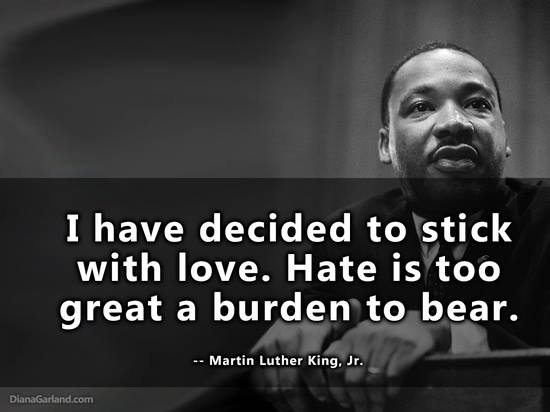
MLK Choose Love


“The Greek language comes out with another word for love. It is the word agape. … agape is something of the understanding, creative, redemptive goodwill for all men. It is a love that seeks nothing in return. It is an overflowing love; it’s what theologians would call the love of God working in the lives of men. And when you rise to love on this level, you begin to love men, not because they are likeable, but because God loves them. You look at every man, and you love him because you know God loves him.” ―Martin Luther King Jr.