God Is Being Itself – Richard Rohr

The great chain of being was the medieval metaphor for ecology before we spoke of ecosystems. While it was structured as a hierarchy, with each link in the chain “closer” to God, I view it as a philosophical and theological attempt to speak of the interconnectedness of all things on the level of pure “Being.” Today we might call it “the circle of life.” If God is Being Itself (Deus est Ens), as both St. Bonaventure and St. Thomas Aquinas taught in the thirteenth century, then the great chain became a way of teaching and preserving the inherent dignity of all things that participate in that Divine Being in various ways. For me, it speaks of the inherent sacrality, interconnectedness, and communality of creation.

These are the links in the great chain of being:

Link 1:  The firmament/Earth/minerals within the Earth
Link 2:  The waters upon the Earth (snow, ice, water, steam, mist)
Link 3:  The plants, trees, flowers, and foods that grow upon the Earth
Link 4:  The animals on the Earth, in the skies, and in the seas
Link 5:  The human species, capable of reflecting on the other links
Link 6:  The heavenly realm/Communion of Saints/angels and spirits
Link 7:  God/the Divine Realm/the Mystery that creates a universe as such, which needs a Center, Source, and Ground for any coherence.

Such a graphic metaphor held all things together in an enchanted universe. If we could not see the sacred in nature and creatures, we soon could not see it at all. [1]

As the medieval theologians predicted, once the chain was broken and one link not honored, the whole vision collapsed. Either we acknowledge that God is in all things, or we have lost the basis for seeing God in anything. Once the choice is ours and not God’s, it is merely a world of private preferences and prejudices. The “cosmic egg” is shattered.

Bonaventure (c. 1217–1274), who is called the second founder of the Franciscan Order, took Francis’ intuitive genius and spelled it out into an entire philosophy. “The magnitude of things … clearly manifests the immensity of the power, wisdom, and goodness of the triune God, who by his power, presence, and essence exists uncircumscribed in all things.” [2] Bonaventure expanded on Alan of Lille’s philosophical idea of God as one “whose center is everywhere and whose circumference is nowhere.” God is “within all things but not enclosed; outside all things, but not excluded; above all things, but not aloof; below all things, but not debased.” [3] Therefore the origin, magnitude, multitude, beauty, fullness, activity, and order of all created things are the very “footprints” and “fingerprints” (vestigia) of God. [4]

[1] Adapted from Richard Rohr, insert in A New Cosmology: Nature as the First Bible (Albuquerque, NM: Center for Action and Contemplation, 2009). Available as MP3 audio download. 

[2] Bonaventure, The Soul’s Journey into God 1.14, trans. Ewert Cousins (New York: Paulist Press, 1978), 65.  

[3] Bonaventure, Soul’s Journey 5.8; Cousins, 100–101. 

[4] Adapted from Richard Rohr, The Wisdom Pattern: Order, Disorder, Reorder (Cincinnati, OH: Franciscan Media, 2001, 2020), 149–150. 
Truth and Reconciliation – Richard Rohr

Almost all religions and cultures that I know of have believed in one way or another that sin and evil are to be punished and retribution is to be demanded of the sinner in this world—and usually the next world, too. Such retributive justice is a dualistic system of reward and punishment, good folks and bad folks, and makes perfect sense to the ego. I call it the economy of merit or “meritocracy.” This system seems to be the best that prisons, courtrooms, wars, and even most of the church (which should know better) appear equipped to do.  

Jesus, many mystics, and other wisdom traditions—such as the Twelve Steps of Alcoholics Anonymous—show that sin and failure are, in fact, an opportunity for the transformation and enlightenment of the offender.  

Mere counting and ledger-keeping are not the way of the Gospel. Our best self wants to restore relationships, and not blame or punish. This is the “economy of grace.” (The trouble is that we defined God as “punisher-in-chief” instead of Healer, Forgiver, and Reconciler and so the retribution model was legitimized all the way down!)  

What humanity really needs is an honest exposure of the truth and accountability for what has happened. Only then can human beings move ahead with dignity. Hurt needs to be spoken and heard. It does not just go away on its own. This can then lead to “restorative justice,” which is what the prophets invariably promise to the people of Israel (see Ezekiel 16:53; Isaiah 57:17–19) and is exemplified in Jesus’ story of the Prodigal Son (Luke 15:11–32) and throughout his healing ministry. We lose that and we lose the Gospel itself. 

As any good therapist knows, we cannot heal what we do not acknowledge. What we do not consciously acknowledge will remain in control from within, festering and destroying us and those around us. In the Gospel of Thomas, Jesus teaches, “If you bring forth that which is within you, it will save you. If you do not bring it forth, it will destroy you.” [1]  

Only mutual apology, healing, and forgiveness offer a sustainable future for humanity. Otherwise, we are controlled by the past, individually and corporately. We all need to apologize and we all need to forgive or this human project will surely self-destruct. No wonder almost two-thirds of Jesus’ teaching is directly or indirectly about forgiveness. Otherwise, history devolves into taking sides, bitterness, holding grudges, and the violence that inevitably follows. As others have said, “Forgiveness is to let go of our hope for a different past.” Reality is what it is, and such acceptance leads to great freedom, as long as there is also both accountability and healing forgiveness. 

[1] Gospel of Thomas, saying 70. For other translations of the Gospel of Thomas and links to additional resources, see http://www.gnosis.org/naghamm/nhl_thomas.htm 

Adapted from Richard Rohr, Breathing under Water: Spirituality and the Twelve Steps 10th anniv. ed. (Cincinnati, OH: Franciscan Media, 2011, 2021), 37–38, 45–46. 

A Warning to Religion from the Garden of Eden – Richard Rohr

The sin warned against at the very beginning of the Bible is “to eat of the tree of the knowledge of good and evil” (Genesis 2:17). It does not sound like that should be a sin at all, does it? But the moment I sit on my throne, where I know with certitude who the good guys and the bad guys are, then I’m capable of great evil—while not thinking of it as evil! I have eaten of a dangerous tree, according to the Bible. Don’t judge, don’t label, don’t rush to judgment. You don’t usually know other people’s real motives or intentions. You hardly know your own.

The author of the classic book The Cloud of Unknowing says that first, you have to enter into “the cloud of forgetting. Forget all your certitudes, all your labels, all your explanations, whereby you’ve put this person in this box, determined this group is going to heaven, decided this race is superior to that race. Just forget it. It’s largely a waste of time. It’s usually your ego projecting itself, announcing itself, and protecting itself. It has little to do with objective reality or real love of the truth. If the world and the world’s religions do not learn this kind of humility and patience very soon, I think we’re in historical trouble.

+Adapted from Beginner’s Mind (Recording).

The Bible Breaks the Pattern – By Richard Rohr

The point that must be remembered is that most of political and church history has been controlled and written by people on the right because they are normally the people in control. One of the few subversive texts in history, believe it or not, is the Bible. The Bible is a most extraordinary text because, again and again, it legitimates, not the people on the top, but invariably the people on the bottom or those who move toward those on the bottom-from Abraham to Moses to Jeremiah to Job to John the Baptist to Jesus. It has taken an amazing degree of denial and selective attention to miss this quite-obvious alternative pattern. After a while, we might get tired of the rejected son, the younger son, the barren woman, the sinner, the outsider always being the chosen one of God! It is the biblical pattern—which we prefer not to see. It takes away our power to exclude “the least of the brothers and sisters” because that is precisely where Jesus says he is to be found (Matthew 25:40)! If indeed women, blacks, members of other religions, gays, and other outsiders are least in our definition, it seems that gives them, in fact, a privileged and revelatory position! They are not to be excluded, but honored. Jesus takes away from us— and from religion —the possibility of creating any class system or any punitive notion. Unfortunately, thus far, it has not worked very well.

+ Adapted from A Lever and a Place to Stand: The Contemplative Stance, the Active Prayer, pp. 98-99.

Incarnationalism – Richard Rohr

Whenever the human and the divine coexist, at the same time, in the same person, you have Christianity. I don’t know that it finally matters what Scriptures you read, liturgies you attend, or moral positions you hold about this or that, as much as it is how you live trustfully inside of God’s one world. This creates honest people, people who don’t waste time proving they’re right, superior, or saved. They just try to live and love the daily mystery that they are in the loving presence of God. “God comes to you disguised as your life,” as Paula D’Arcy proclaimed the first time we taught together. Imagine that!

There are basically four worldviews: (1) reality is just matter, (2) reality is just spirit, (3) through religion and morality, you can work to put matter and spirit together (the most common religious position), and (4) the material world has always been the place where Spirit is revealed. You cannot put them together–they already are together, as in Jesus. Only the fourth position, incarnationalism, deserves to be called authentic Christianity. It has little to do with the right rituals, only the right reality.

+ Adapted from Great Themes of Paul: Life as Participation (Recording).

Resurrection as the Revelation of What was Always True – Richard Rohr

In the Risen Christ, God reveals the final state of all reality. God forbids us to accept as it is in favor of what God’s love can make it. To believe in resurrection means to cross limits and transcend boundaries. Because of the promise of the resurrection of Jesus, we realistically can believe that tomorrow can be better than today. We are not bound by any past. There is a future that is created by God and much bigger than our own efforts.We should not just believe in some kind of survival or immortality or just”Life after death” but resurrection, an utterly new creation, a transformation into Love that is promised as something that can happen in this world and is God’s final chapter for all of history. That is why a true Christian must be an optimist. In fact, if you are not an optimist, you haven’t got it yet.

+ Adapted from Radical Grace: Daily Meditations, p. 150.

The God You Meet in Prayer – Richard Rohr

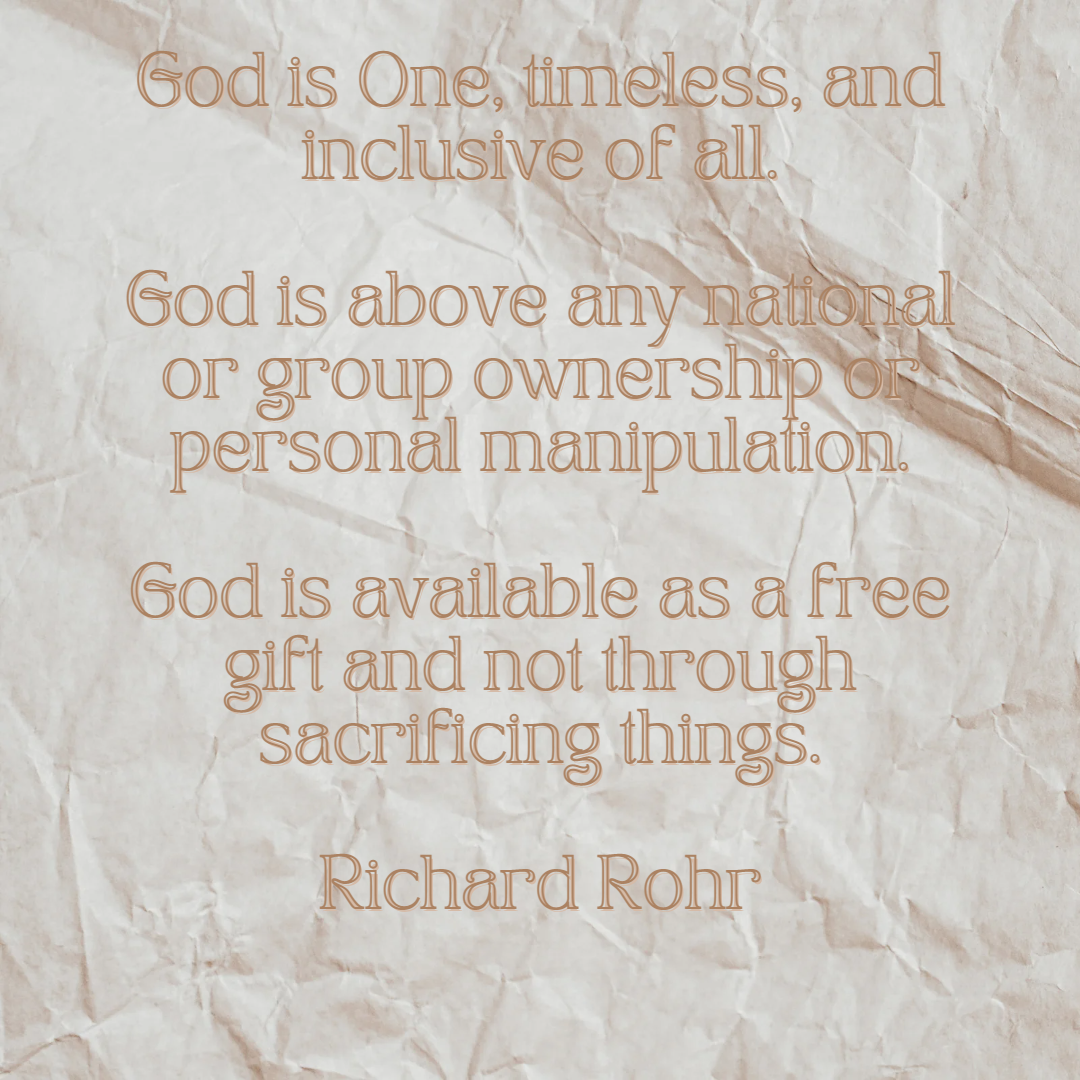
God is One, timeless, and inclusive of all.

The True Sacred, which is what you are seeking in prayer and silence, always reveals that:

God is above any national or group ownership or personal manipulation.

God is available as a free gift and not through sacrificing things.

God needs no victims and creates no victims. Jesus ends religion as sacrifice “once and for all’ by revealing the tragic effects of scapegoating through what happened to him on the cross (Hebrews 7:27, 10:10).

Jesus personifies this type of God and speaks defiantly in defense of such a God. Nowhere is he more succinct than when he quotes the prophet Hosea, “Go and learn the meaning of the words: ‘Mercy is what pleases me, not sacrifices” (Matthew 9:13).

+Adapted from Jesus’ Plan for a New World: The Sermon on the Mount, p. 5.

Spacious Silence Allows a Spacious God

This is one good thing that silence and waiting have taught me: Our lives are always useable by God. We need not always be effective, but only transparent and vulnerable. Then we are instruments, no matter what we do.

Silence is the ability to trust that God is acting, teaching, and using us-even before we perform or after our seeming failures. Silence is the necessary space around things that allows them to develop and flourish without our pushing.

God takes it from there, and there is not much point in comparing who is better, right, higher, lower, or supposedly saved. We are all partial images, slowly coming into focus, as long as we allow and filter the Light and Love of God, which longs to shine through us-as us!

+Adapted from Contemplation in Action, p. 134. By Richard Rohr

GOD DOES NOT LOVE US BECAUSE WE ARE GOOD; WE ARE GOOD BECAUSE GOD LOVES US – Richard Rohr

The great thing about God’s love is that it’s not determined by the object.

God does not love us because we are good. God loves us because God is good.

It takes our whole lives for that to sink in, along with lots of trials and testing of divine love, because that’s not how human love operates.

Human love is largely determined by the attractiveness of the object.

When someone is nice, good, not high-maintenance, physically attractive, important, or has a nice personality, we find it much easier to give ourselves to them or to “like” them. That’s just the way we humans operate.

We naturally live in what I call the meritocracy of quid pro quo. We must be taught by God and grace how to live in an economy of grace. Divine love is a love that operates in a quite unqualified way, without making distinctions between persons and seemingly without such a thing as personal preference. Anyone who receives divine love feels like God’s favorite in that moment! We don’t even have the capacity to imagine such a notion until we have received it! Divine love is received by surrender instead of any performance principle whatsoever.

+Adapted from Following the Mystics through the Narrow Gate…

Seeing God in All Things (Recording).

We Know Through The Concrete More Than By Universal Theories – Richard Rohr

God’s revelations are always pointed, concrete, and specific. They come not from a Platonic world of ideas and theories about which we can be right or wrong or observe from a distance. Divine Revelation is not something we measure or critique. It is not an ideology, but a Presence we intuit and meet! It is more Someone than something.

All of this is called the “mystery of incarnation”-enfleshment or embodiment, if you prefer and for Christians it reaches its fullness in the incarnation of God in one ordinary looking man named Jesus. God materialized in human form so we could fall in love with a real person, which is the only way we fall in love at all. Walter Brueggemann called this clear Biblical pattern “the scandal of the particular.” We first get the truth in one specific, ordinary place and moment (like the one man, Jesus), and then we universalize from that to the universal truth (the cosmic Christ). Our Franciscan philosopher John Duns Scotus called this the principle of “thisness” (haecceity or haecceitas in Latin). We can only know in focused moments what is always and everywhere true.

+Adapted from Things Hidden: Scripture as Spirituality, p. 17.