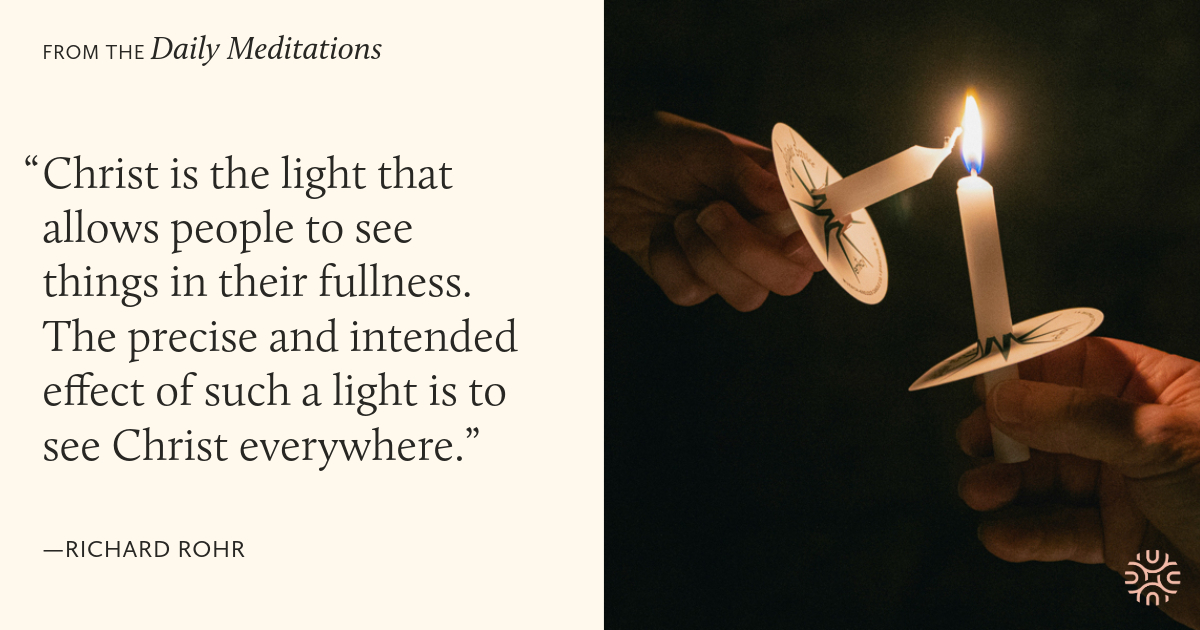
In his final 2025 Daily Meditation, Father Richard Rohr invites us to reconsider a familiar phrase: “the light of the world.” While often used as a title for Jesus, Rohr highlights that Jesus famously turned the phrase back to his followers, telling them, “You are the light of the world.”
This shift suggests that light isn’t just something we look at, but rather the lens through which we see everything else.
The Messenger vs. The Message
Rohr argues that many Christians have fallen into the trap of worshipping the messenger (Jesus) while ignoring his actual message. He points out that:
Jesus asked us many times to follow him, but never once to worship him.
The goal of faith is not just to have “faith in Christ,” but to develop the “faith of Christ.”
A mature spiritual life is marked by the ability to look at the world with Jesus’ eyes—a perspective that is broad, deep, and all-inclusive.
The “Forever Coming” of Christ
Drawing from the Gospel of John, the article describes the Incarnation not as a one-time historical event, but as an ongoing, evolutionary movement.
Rather than viewing the “Second Coming” as a future threat, Rohr reinterprets it as the “forever coming of Christ.” It is the constant unfolding of the Divine within creation, a promise of eternal resurrection that has been at work since the beginning of time.
A New Definition of a Christian
Ultimately, the post defines a mature Christian as someone who sees Christ in everyone and everything. This way of seeing leaves no room for:
Fighting or exclusion
Rejecting others
Pious substitutes for active love
When we allow the “true light” to enlighten us, we stop seeking a provable conclusion and become a conduit for love in the world.
In the November 28, 2025, edition of Richard Rohr’s Daily Meditations, the spiritual practice of gratitude is highlighted through the lens of psychological and spiritual growth. The meditation — titled “Minding Positivity” — makes a startling claim: our brains may be wired to cling to negativity. Like Velcro, we instinctively hold on to problems, fears, and regrets, while letting positive experiences slip away like cheese on hot Teflon.
This tendency — to dwell on what’s wrong rather than celebrate what’s good — can shape how we view ourselves, our lives, and the world. But Rohr draws on neuroscience (notably the work of Rick Hanson) to show that the brain is malleable: by consciously choosing to hold onto positives for at least fifteen seconds, we can recondition our minds.
In other words: gratitude isn’t optional. It’s a spiritual discipline. By repeatedly turning toward love, trust, patience, and goodness — even in small moments — we gradually build “neuroplasticity”: an increased bandwidth for freedom, openness, and compassion. Rohr frames this rewiring as the very heart of authentic spirituality.
Why This Matters More Than Ever
We live in a negativity-saturated world. Between media cycles, social pressure, and personal anxieties, it’s easy to let negativity dominate our inner narrative. This meditation cuts directly across that tendency.
Spirituality isn’t just about morality — it’s about psychology. By linking contemplative practices to brain science, the text bridges faith and neuroscience. Gratitude becomes a practical, embodied discipline.
Small shifts can lead to profound transformation. You don’t need great insight or dramatic experiences — just small, regular conscious choices to linger in gratitude. Over time, that can change how you see yourself, others, and your place in the world.
Key Takeaways and Invitation
Start simple: notice one small good thing today and hold on to it, mentally or in a journal, for at least 15 seconds.
When negativity or fear arises, gently reorient to something authentic, lovely, or kind — even if it feels small or insignificant.
See gratitude not as a passing “positive vibe,” but as a spiritual and neurological discipline: a way to expand your capacity for love, acceptance, and presence.
Recognize that this kind of transformation — from fear to trust, from reactivity to stillness — is not optional or secondary. It’s essential.
Oprah and Rohr explore the transformative power of embracing tears as a path to healing and societal change, drawing on decades of theological study. Father Rohr weaves the wisdom of Old Testament prophets into our culture, showing how their cries for justice and renewal offer examples for our own breakthroughs. Throughout the episode, Rohr responds to questions from guests seeking to embody his philosophy in their careers, relationships, and everyday life.
Father Richard Rohr invites us to consider how well we love others, especially the stranger, as Jesus teaches:
If our love of God doesn’t directly influence, and even change, how we engage in the issues of our time, I wonder what good religion is. “God talk” becomes an opaque screen in which we see only reflections of ourselves, rather than any kind of true light. “Anyone who says they love God, and hates their brother or sister, is a liar” (1 John 4:20). None of us wants to be a liar, yet religion’s high goals make failure almost inevitable for all of us (read Paul’s attempts to describe this paradoxical phenomenon in Romans 7:7–25). Our daily question is this: “Have I even begun to love?”
Most Christians tend to echo the cultural prejudices and worldviews of the dominant group in their country, with only a minority revealing any real transformation of attitudes or consciousness. It has been true of slavery and racism, classism and consumerism, and issues of immigration and health care for the poor. From a religion based on a man who was always healing poor people and praising foreigners, it defies any logical analysis!
One would think that people who insist they believe in one God would understand that everyone on Earth is equally a child of that one God. Christians ought to be first in line to cross artificial boundaries created by nation states, class systems, cultures, and even religions. Often, we’re the last! It makes one wonder if we believe what we say we believe. Religion too often becomes the way to defend the self instead of the way to “let go of the self” as Jesus forthrightly taught (see Luke 9:23). [1]
Pope Francis reminds Christians of their duty to welcome the stranger:
Let us concentrate on these words of Jesus: “I was a stranger and you welcomed me, I was naked and you clothed me” (Matthew 25:35–36). In our time, charitable action regarding foreigners is more relevant than ever. The economic crisis, armed conflicts, and climate change have forced many people to emigrate. However, migration is not a new phenomenon; it is part of the history of humanity. It is a lack of historical memory to think that this phenomenon has arisen only in recent years….
At times it seems that the silent work of so many men and women who, in various ways, do all they can to help and assist the refugees and migrants is obscured by the clamor of others who give voice to an instinctive selfishness. However, closure is not a solution, but instead ends up fostering criminal trafficking. The only path to a solution is through solidarity. Solidarity with the migrant, solidarity with the foreigner….
We all … are called to welcome our brothers and sisters who are fleeing from war, from hunger, from violence and from inhuman living conditions. All together we are a great supportive force for those who have lost their homelands, families, work, and dignity. [2]
[1] Adapted from Richard Rohr, “We Have Not Yet Begun to Love: Religion and Immigration,” Radical Grace 24, no. 4 (2011): 3.
[2] Pope Francis, “A Stranger and You Welcomed Me,” in A Stranger and You Welcomed Me: A Call to Mercy and Solidarity with Migrants and Refugees, ed. Robert Ellsberg (Orbis, 2018), 53, 54, 55.
Image credit and inspiration: Lucas Dalamarta, Untitled (detail), 2024, photo, Unsplash. Click here to enlarge image.When engaging with an unknown being we practice holding space for the other and leading with an open heart, even when we don’t know the outcome.
Shared by Center for Action and Contemplation – Daily Meditations – Join for free.
Yet before you can love your neighbor—your brother or sister—as yourself, you must first love yourself. And to first love yourself, you must know that God loves you now and loves you always. —Archbishop Desmond Tutu, God Has a Dream
Richard Rohr connects our ability to love others with our ability to receive God’s love.
Authentic love is of one piece. How we love anything is how we love everything. Jesus commands us to “Love our neighbors as we love ourselves,” and he connects the two great commandments of love of God and of neighbor, saying they are “like” one another (Matthew 22:39). So often, we think this means to love our neighbor with the same amount of love—as much as we love ourselves—when it really means that it is the same Source and the same Love that allows us to love ourselves, others, and God at the same time! That is unfortunately not the way most people understand love, compassion, and forgiveness—yet it is the only way they ever work.
We cannot sincerely love another or forgive offenses inside of dualistic consciousness. Many pastors and priests have done the people of God a great disservice by preaching the gospel to them but not giving them the tools to live it out. As Jesus put it, “Cut off from the vine, you can do nothing” (John 15:5). The “vine and the branches” offer one of the greatest Christian mystical images of the non-duality between God and the soul. In and with God, I can love everything and everyone—even my enemies. Alone and by myself, my willpower and intellect will seldom be able to love in difficult situations over time. Many folks try to love by willpower, with themselves as the only source. They try to obey the second commandment without the first. It never works long-term.
Finally, of course, there’s a straight line between love and suffering. If we love anyone or anything deeply and greatly, it’s fairly certain we’ll soon suffer because we have offered control to another, and the cost of self-giving will soon show itself. Undoubtedly, this is why we are told to be faithful in our loves, because such long-term loyalty and truly conscious love will always lead us to the necessary pruning (John 15:2) of the narcissistic self.
Until we love and until we suffer, we all try to figure out life and death with our minds. Then a Larger Source opens up within us and we “think” and feel quite differently through “knowing the Love, which is beyond all knowledge” (Ephesians 3:19). Thus, Jesus would naturally say something like, “This is my commandment: you must love one another!” (John 13:34). Authentic love (which is always more than an emotion) initially opens the door of awareness and aliveness, and then suffering for that love keeps that door open for mind, body, and will to enter. I suspect for most of us that is the work of a lifetime.
We shall not cease from exploration / And the end of all our exploring / Will be to arrive where we started / And know the place for the first time. —T. S. Eliot, Four Quartets
In the Everything Belongs podcast, Father Richard speaks about the spiritual path that winds both away from and toward one’s true home:
The first going out from home we can say is the creation of the ego. While this is a necessary creating, it is also the creating of a separation. It’s taking myself as central. We probably need to do that, at least until we reach middle age. But then we need to allow what we’ve created to be uncreated. Maybe I was a great basketball player, but that’s gone now. Or maybe I was good-looking, but that’s gone now.
When we can say “yes” to that uncreation and still be happy, we’ve done our work. My True Self is in God and not in what I’ve created. My self-created self gave me a nice trail to walk on, and something to do each day, but it isn’t really me. It might be my career or my vocation; yet as good as it is, it isn’t my True Self.
In the metaphor of life as a journey, I think it’s finally about coming back home to where we started. As I approach death, I’m thinking about that a lot, because I think the best way to describe what’s coming next is not “I’m dying,” but “I’m finally going home.” I don’t know what it’s like yet, but in my older age I can really trust that it is home. I don’t know where that trust comes from or even what home is like, but I know I’m not going to someplace new. I’m going to all the places I’ve known deeply. They’re pointing me to the big deep, the Big Real. I do think homecoming is what it’s all about.
Father Richard continues to reflect upon finding his home in God in this season of his life:
Well first, I have to say, I don’t fully know how to live there. I’m used to living for 80 years out of building an education, a persona, a reputation, a career. When we’ve worked at those things for so long, on a very real level we don’t know how to live without them. But thank God, they’re taken away from us. God slows us down, I think necessarily, or we won’t fall into the True Self.
My understanding of the second half of life is mostly homesickness for the True Self. I want to learn to be who God really created me to be. And I think all God wants me to be is who I really am.
Where are we going? After a very short visit to earth the time comes for each of us to pass from this world to the next. We have been sent into the world as God’s beloved children, and in our passages and our losses we learn to love each other as spouse, parent, brother, or sister. We support one another through the passages of life, and together we grow in love.
Finally, we ourselves are called to exodus, and we leave the world for full communion with God. It is possible for us, like Jesus, to send our spirit of love to our friends when we leave them. Our spirit, the love we leave behind, is deeply in God’s Spirit. It is our greatest gift to those we love.
We, like Jesus, are on a journey, living to make our lives abundantly fruitful through our leaving. When we leave, we will say the words that Jesus said: “It is good for you that I leave, because unless I pass away, I cannot send you my spirit to help you and inspire you.”
Self-knowledge and self-love are the fruit of knowing and loving God. You can see better than what is intended by the great commandment to “love the Lord your God with all your heart, with all your soul, and with all your mind, and to love your neighbor as yourself.” Laying our hearts totally open to God leads to a love of ourselves that enables us to give wholehearted love to our fellow human beings. In the seclusion of our hearts, we learn to know the hidden presence of God; and with that spiritual knowledge, we can lead a loving life.
“Be completely humble and gentle; be patient, bearing with one another in love.” – Ephesians 4: 2 (NIV)
Do not hesitate to love and to love deeply. You might be afraid of the pain that deep love can cause. When those you love deeply reject you, leave you, or die, your heart will be broken. But that should not hold you back from loving deeply. The pain that comes from deep love makes your love even more fruitful. It is like a plow that breaks the ground to allow the seed to take root and grow into a strong plant. Every time you experience the pain of rejection, absence, or death, you are faced with a choice. You can become bitter and decide not to love again, or you can stand straight in your pain and let the soil on which you stand become richer and more able to give life to new seeds.




 The Blessed Fool