Only Love Can Handle the Truth – Richard Rohr


The contemplative mind does not need to prove anything or disprove anything. It’s what the Benedictines called a Lectio Divina, a reading of the Scripture that looks for wisdom instead of quick answers. It first says, “What does this text ask of me? How can I change because of this story?” rather than “How can I use this to prove that I am right and others are wrong or sinful?”


The contemplative mind is willing to hear from a beginner’s mind, yet also learn from Scripture, Tradition-and others. It has the humility to move toward Yes/And thinking and not all-or-nothing thinking. It leads to a third way, which is neither fight nor flight, but standing in between where we can hold what we do know together with what we don’t know. Holding such a creative tension with humility and patience leads us to wis dom instead of easy answers, which largely create opinionated and smug people instead of wise people. We surely need wise people now, who hold their truth humbly and patiently.


+Adapted from What is the Emerging Church? (Recording)

Eating Your True Self – Richard Rohr


Jesus says, “If you eat this bread, you will live forever” (John 6:51). It is so interesting that he chooses something with taste, flavor, and nutrition as the symbol of how life is transferred, rather than intellectual cognition. If you live by the momentary identity that others give you, that’s what dies when you die, and you’re left with nothing. Your relative identity passes away, but it is like the painful erasing of an unwanted tattoo. When Jesus says he’s giving himself to you as the bread of life, he’s saying, as it were, “Find yourself in me and this will not pass or change or die. Eat this food as your primary nutrition and you are indestructible.” This is your absolute and indestructible identity.
You slowly learn how to live in what Thomas Merton would call the True Self-who you are and always have been, in God. Who you are in God is who you forever are. In fact, that’s all you are, and it is more than enough. Everything else is passing away. Reputations, titles, possessions, and roles do not determine your identity. When I hand out the Eucharistic bread, I love to say to the assembly, “You become what you eat. Come and eat who you are-forever!” You access Great Truth by absorption and digestion, almost never by analysis or argumentation.


+Adapted from Eucharist as Touchstone (Recording).

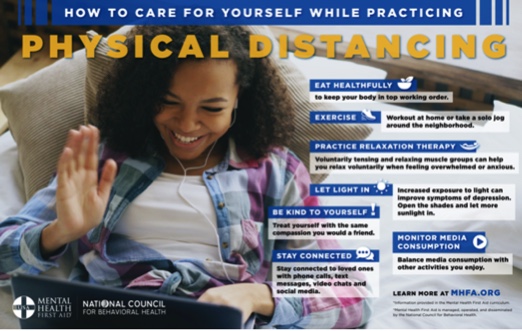
How to care for yourself while practicing physical distancing – By Rubina Kapil

1232A79C-D47A-4D8B-84CA-C93DF9CA9855_4_5005_c

If you or someone you care about feels overwhelmed with emotions like sadness, depression or anxiety, or like you want to harm yourself or others call 911.

You can also contact the Substance Abuse and Mental Health Services Administration’s (SAMHSA) Disaster Distress Helpline at 800-985-5990, the National Suicide Prevention Lifeline at 800-273-8255 or text MHFA to 741741 to talk to a Crisis Text Line counselor.

This is a stressful time for many. With the government and media sharing updates throughout the day and the fear of the unknown, it is understandable to feel overwhelmed, stressed and anxious. You are not alone.

Millions of people across the country are facing the same worries and challenges that you are. During this time, it is important to remember that it’s OK to not be OK. It’s also important to take care of your mental health.

While practicing physical distancing, there are easy self-care strategies that can help reduce feelings of depression and anxiety, or prevent anxiety before it even starts.

Use these tips from the MHFA curriculum to take care of your mental health while practicing physical distancing.

  1. Eat healthfully to keep your body in top working order.
  2. Exercise reduces symptoms of depression and anxiety, whether we’re working out at home or taking a solo jog around the neighborhood.
  3. Practice relaxation therapy. Focusing on tensing and relaxing muscle groups can help you relax voluntarily when feeling overwhelmed, stressed or anxious.
  4. Let light in. For some people, increased exposure to light can improve symptoms of depression. If you can, open the shades and let more sunlight in.
  5. Be kind to yourself! Treat yourself with the same compassion you would a friend.
  6. Stay connected. Even if you can’t get together face-to-face, you can stay connected to friends, family and neighbors with phone calls, text messages, video chats and social media. If you’re feeling lonely, sad or anxious, reach out to your social support networks. Share what you are feeling and offer to listen to friends or family members about their feelings. We are all experiencing this scary and uncertain time together.
  7. Monitor media consumption. While you might want to stay up-to the minute with COVID-19 news, too much exposure can be overwhelming. Balance media consumption with other activities you enjoy, such as reading, cooking or listening to music.

Self-care doesn’t require you to go outside or spend a lot of money. Adding small changes to your routine can make a big difference to your overall mood and well-being.

Thank you for choosing to #BeTheDifference and remember to practice self-care with Mental Health First Aid.

Incarnation – Celebrating an Eternal Advent – by Richard Rohr

In the first 1200 years of Christianity, the greatest feast was Easter with the high holy days of Holy Week leading up to the celebration of the resurrection of Christ. But in the 13th century, a new person entered the scene: Francis of Assisi felt we didn’t need to wait for God to love us through the cross and resurrection. Francis intuited that the whole thing started with incarnate love, and he popularized what we now take for granted as Christmas, which for many became the greater Christian feast. The Franciscans popularized Christmas. Maybe their intuition was correct.

Francis realized that if God had become flesh—taken on materiality, physicality, humanity—then we didn’t have to wait for Good Friday and Easter to “solve the problem” of human sin; the problem was solved from the beginning. It makes sense that Christmas became the great celebratory feast of Christians because it basically says that it’s good to be human, it’s good to be on this earth, it’s good to be flesh, it’s good to have emotions. We don’t need to be ashamed of any of this. God loves matter and physicality.

With that insight, it’s no wonder Francis went wild over Christmas! (I do, too: my little house is filled with candles at Christmastime.) Francis believed that every tree should be decorated with lights to show their true status as God’s creations! And that’s exactly what we still do 800 years later.

Remember, when we speak of Advent or preparing for Christmas, we’re not just talking about waiting for the little baby Jesus to be born. That already happened 2,000 years ago. In fact, we’re welcoming the Universal Christ, the Cosmic Christ, the Christ that is forever being born in the human soul and into history.

And believe me, we do have to make room, because right now there is no room in the inn for such a mystery. We see things pretty much in their materiality, but we don’t see the light shining through. We don’t see the incarnate spirit that is hidden inside of everything material.

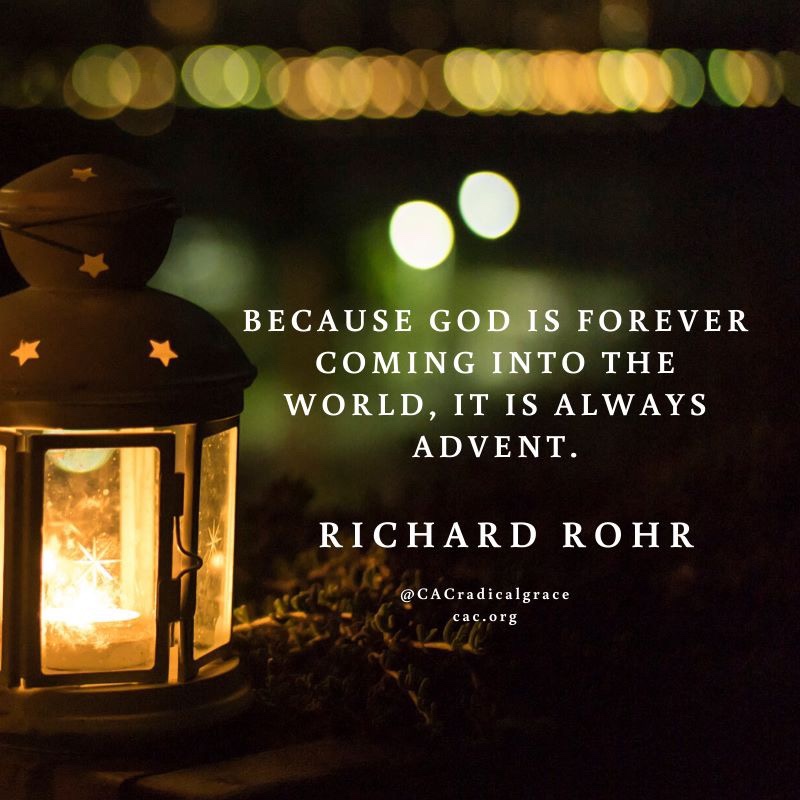
The early Eastern Church, which too few people in the United States and Western Europe are familiar with, made it very clear that the incarnation was a universal principle. Incarnation meant not just that God became Jesus; God said yes to the material universe. God said yes to physicality. Eastern Christianity understands the mystery of incarnation in the universal sense. So it is always Advent. God is forever coming into the world (see John 1:9).

We’re always waiting to see spirit revealing itself through matter. We’re always waiting for matter to become a new form in which spirit is revealed. Whenever that happens, we’re celebrating Christmas. The gifts of incarnation just keep coming. Perhaps this is enlightenment.

My Bible Is as Worn as Theirs – by Rev. Greg Weeks

I fervently believe that you honor God’s Word by using your brain, the most magnificent creation in the known universe. You honor God’s Word by taking modern knowledge to ancient texts. You honor God’s Word by reflecting on Scripture as you learn from your experiences with people, the more the better. You honor God’s Word by listening to how others interpret it who have backgrounds, lifestyles, cultures, and ethnicities different from your own.

Read the full blog entry – https://revgregweeks.com/my-bible-is-as-worn-as-theirs/

A tiny ripple of hope…

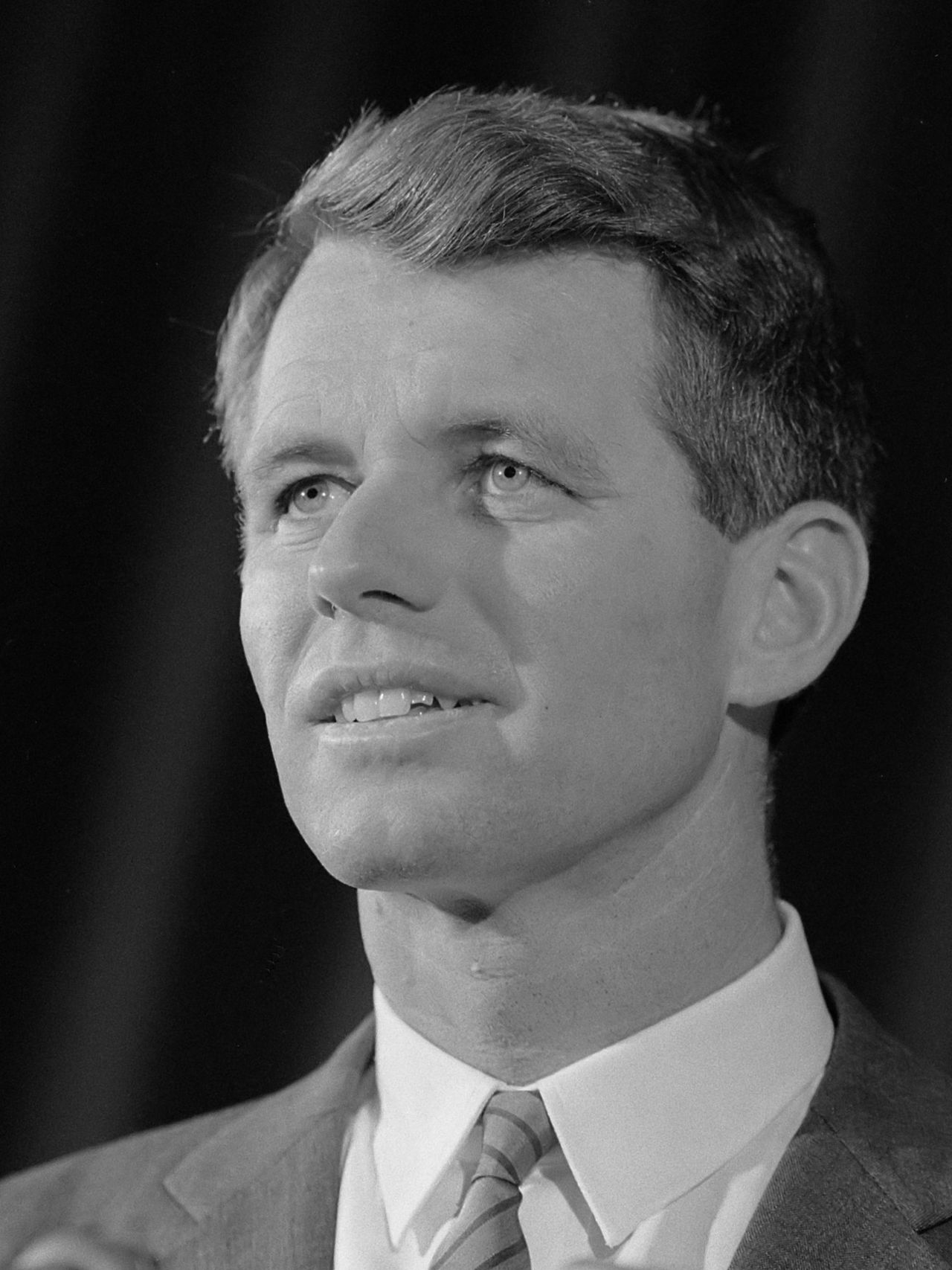
In 1966, thirty long years before the fall of Apartheid, South African students heard Robert Kennedy proclaim:

“Some believe there is nothing one man or one woman can do against the enormous array of the world’s ills. Yet many of the world’s great movements of thought and action have flowed from the work of a single person… It is from numberless diverse acts of courage and belief that human history is shaped. Each time a person stands up for an ideal, or acts to improve the lot of others, or strikes out against injustice, he or she sends forth a tiny ripple of hope. And crossing each other from a million different centers of energy and daring, those ripples build a current that can sweep down the mightiest walls of oppression and resistance.”

Robert_Kennedy_(1962)

Rachel Held Evans – “Damn right, I’ve gotten political.”

evans (1)

Rachel Held Evans is a progressive Christian blogger and author of the books Faith Unraveled, A Year of Biblical Womanhood and Searching for Sunday.  Evans is also a prolific Facebook and Twitter poster who often stirs fiery debates in the comments sections with her posts. Here is her latest blog.


You don’t like that I’ve “gotten political,” huh?

If saying it’s wrong to mock people with disabilities makes me political, then so be it.

If rejecting the notion that demeaning, groping, insulting, and assaulting women is “just how men are” makes me political, then so be it.

If supporting a free press makes me political, then so be it.

If speaking out when religious and ethnic minorities are targeted with misinformation campaigns that have dramatically increased hate crimes against them makes me political, then so be it.

If believing the president of the United States is not above the rule of law, or the most basic ethical accountability, makes me political, then so be it.

If refusing to stand by as desperate refugee families, including many children, are turned away from safety based on misinformation and fear makes me political, then so be it.

If calling my senators to oppose a healthcare bill that would likely increase the abortion rate and definitely leave my friends with special needs kids bankrupt and desperate makes me political, then so be it.

If expecting the president of the United States to behave with some semblance of decorum and decency, even on Twitter, makes me political, then so be it.

If getting angry when Christian leaders shrug off sexual assault, lying, racism, bullying, cruelty to the vulnerable, and unapologetic greed and self-aggrandizement because it gets them the judge they want or the power they crave makes me political, then so be it.

If turning over tables when Christians sing hymns in honor of this administration’s ethno-nationalist agenda makes me political, then so be it.

You don’t like that I’ve gotten political?

I don’t like that the future of the Republic and the integrity of the American Church has been so glibly handed over to a man who has no respect for either.

You’re damn right I’ve gotten political.

And even if you remain silent, you have too.

– Well said, Rachel! I couldn’t agree with you more.
Jesus as Scapegoat by Richard Rohr


Jesus on the cross echoes three healing images: the Passover lamb, the “Lifted-Up One,” and the scapegoat ritual. The third symbol deserves a deeper exploration because it is central to understanding how Jesus resets the pattern of history. We’ll spend this week looking at Jesus as scapegoat before we move on to the promise of resurrection.
Humans have always struggled to deal with fear and evil by ways other than forgiveness, most often through sacrificial systems. Philosopher René Girard (1923-2015) saw the tendency to scapegoat others as the primary story line of human history in every culture. [1] Why? Because it works, and it is largely an immediate and an unconscious egoic response. The scapegoat mechanism was ritualized by the Israelites, as we’ll see tomorrow (see Leviticus 16:20-22).
If your ego is still in charge, you will find a “disposable” person or group on which to project your problems. People who haven’t come to at least a minimal awareness of their own dark side will always find someone else to hate or fear. Hatred holds a group together much more quickly and easily than love and inclusivity, I am sorry to say. Something has to be sacrificed. Blood has to be shed. Someone has to be blamed, attacked, tortured, imprisoned, or killed. Sacrificial systems create religions and governments of exclusion and violence. Yet Jesus taught and modeled inclusivity and forgiveness!
Sadly, the history of violence and the history of religion are almost the same history. When religion remains at the immature level, it tends to create very violent people who ensconce themselves on the side of the good, the worthy, the pure, the saved. They project all their evil somewhere else and attack it over there. At this level, they export the natural death instinct onto others, as though it’s someone else who has to die.
As long as you can deal with evil by some means other than forgiveness, you will never experience the real meaning of evil and sin. You will keep projecting, fearing, and attacking it over there, instead of “gazing” on it within and “weeping” over it within yourself and all of us. The longer you gaze, the more you will see your own complicity in and profitability from the sin of others, even if it is the satisfaction of feeling you are on higher moral ground. Forgiveness demands three new simultaneous “seeings”: I must see God in the other; I must access God in myself; and I must experience God in a new way that is larger than an “Enforcer.”

References:

[1] I highly recommend James Alison’s exploration of René Girard’s work, particularly Alison’s four-part study series Jesus the Forgiving Victim: Listening for the Unheard Voice (DOERS Publishing: 2013), http://www.forgivingvictim.com/.

Adapted from Richard Rohr, Things Hidden: Scripture as Spirituality (Franciscan Media: 2008), 193-194.

Sign up to receive CAC’s free daily, weekly, or monthly emails for yourself by clicking here!

Richard Rohr’s Daily Meditations are made possible through the generosity of CAC’s donors. Please consider making a tax-deductible donation. Click here to donate securely online.