There are Many Ways to Experience God – Richard Rohr

A very little bit of God goes an awfully long way. When another’s experience of God isn’t exactly the way I would describe it, it doesn’t mean that they haven’t had an experience of God or that their experience is completely wrong. We have to remain with Francis’s prayer: “Who are you, God, and who am I?” Isn’t there at least ten percent of that person’s experience of God with which I can agree? Can’t I at least say, “I wish I could experience God in that way”?

What characterizes anyone who has had just a little bit of God is that they always want more of that experience! Could it not be that this Hindu, this Sufi, this charismatic, this Jew has, in fact, touched upon the same eternal Mystery that I am seeking? Can’t we at least give one another the benefit of the doubt? I can be somewhat patient with people who think they have the truth.

The problem for me is when they think they have the whole truth. The mystic probably represents the old shibboleth, “Those who really know don’t speak too quickly. Those who speak too quickly don’t really know.”

+Adapted from Following the Mystics through the Narrow Gate…Seeing God in All Things (Recording).

The Bible Breaks the Pattern – By Richard Rohr

The point that must be remembered is that most of political and church history has been controlled and written by people on the right because they are normally the people in control. One of the few subversive texts in history, believe it or not, is the Bible. The Bible is a most extraordinary text because, again and again, it legitimates, not the people on the top, but invariably the people on the bottom or those who move toward those on the bottom-from Abraham to Moses to Jeremiah to Job to John the Baptist to Jesus. It has taken an amazing degree of denial and selective attention to miss this quite-obvious alternative pattern. After a while, we might get tired of the rejected son, the younger son, the barren woman, the sinner, the outsider always being the chosen one of God! It is the biblical pattern—which we prefer not to see. It takes away our power to exclude “the least of the brothers and sisters” because that is precisely where Jesus says he is to be found (Matthew 25:40)! If indeed women, blacks, members of other religions, gays, and other outsiders are least in our definition, it seems that gives them, in fact, a privileged and revelatory position! They are not to be excluded, but honored. Jesus takes away from us— and from religion —the possibility of creating any class system or any punitive notion. Unfortunately, thus far, it has not worked very well.

+ Adapted from A Lever and a Place to Stand: The Contemplative Stance, the Active Prayer, pp. 98-99.

The Sin of Exclusion – Richard Rohr

Those at the edge of any system and those excluded from any system ironically and invariably hold the secret for the conversion and wholeness of that very group. They always hold the feared, rejected, and denied parts of the group’s soul. We see, therefore, why the church was meant to be that group that constantly went to the edges, to the least of the brothers and sisters, and even to the enemy. Jesus was not just a theological genius; he was also a psychological and sociological genius. Therefore, when any church defines itself by exclusion of anybody, it is always wrong. It is avoiding its only vocation, which is to be the Christ. The only groups that Jesus seriously critiques are those who include themselves and exclude others from the always-given grace of God.

Only as the People of God receive the stranger, the sinner, and the immi-grant, those who don’t play our game our way, do we discover not only the hidden, feared, and hated parts of our own souls, but also the fullness of Jesus himself. We need them for our own conversion.

The church is always converted when the outcasts are re-invited back into the temple. We see this in Jesus’s common action of sending marginalized people that he has healed back into the village, back to their family, or back to the Temple to show themselves to the priests. It is not just for their re-inclusion and acceptance, but actually for the group itself to be renewed.

+ Adapted from Radical Grace: Daily Meditations, p. 28.

As Close as Our Breath – Richard Rohr

On this Feast of Pentecost, Father Richard reminds us that the Holy Spirit is as near to us as our own breath:   

Jesus said to them again, “Peace be with you. As the Father has sent me, so I send you.” And when he had said this, he breathed on them and said to them, “Receive the Holy Spirit” (John 20:21–22).  

God has been trying through all of history to give away God. Jesus shows us that the gift is free and totally available, as available as our breath. It seems that God has a hard time giving away God, however, because most of us aren’t interested. We’re interested in other things: money and power and success and good looks and politics. It takes a long time to get around to the one thing we were created for.   

If you’ve ever ridden on the subways in London, before the doors open and you get out of the train, they say, “Mind the gap.” When the doors open, it’s written in big words in front of every door: “Mind the gap.” It means, of course, that there are a few inches between the doors and the sidewalk, and they don’t want anyone to fall in that gap.   

In teaching on the Holy Spirit, what we need to do is “mind the gap”—because the Holy Spirit fills the gaps of everything. First, we need to be aware that there usually is a gap. There’s a space because we don’t recognize that God is as available to us as our breath. We always allow God, by our own silliness and stupidity, to be distant, to be elsewhere. We always find a gap between ourselves and our neighbor, between ourselves and almost everything. We therefore feel quite lonely and isolated in this world. Without some awareness of the Holy Spirit’s presence, frankly, we’re not connected to anything or anybody. We just live an isolated life.   

The Holy Spirit within us is the desire inside all of us that wants to keep connecting, relating, and communing. It isn’t above us. It isn’t beyond us—it is within us. It’s as available as our breath, and that’s why the Risen Christ gives the Holy Spirit by breathing upon the disciples. He’s saying, in effect, “Here it is! Here it is! Can you breathe in what I have breathed out?” 

As we grow on the journey, we’ll begin to experience that breath, that Spirit, as if it is the very air. It’s everywhere, all the time, and we can’t live one minute without it. Isn’t it amazing that air, the thing that’s most essential, most invisible to most people is the one thing that’s everywhere all the time and free? The Holy Spirit likewise has been given to us freely. 

Adapted from Richard Rohr, “Pentecost Sunday: The Divine Sparkplug,” homily, May 15, 2016.  
Incarnationalism – Richard Rohr

Whenever the human and the divine coexist, at the same time, in the same person, you have Christianity. I don’t know that it finally matters what Scriptures you read, liturgies you attend, or moral positions you hold about this or that, as much as it is how you live trustfully inside of God’s one world. This creates honest people, people who don’t waste time proving they’re right, superior, or saved. They just try to live and love the daily mystery that they are in the loving presence of God. “God comes to you disguised as your life,” as Paula D’Arcy proclaimed the first time we taught together. Imagine that!

There are basically four worldviews: (1) reality is just matter, (2) reality is just spirit, (3) through religion and morality, you can work to put matter and spirit together (the most common religious position), and (4) the material world has always been the place where Spirit is revealed. You cannot put them together–they already are together, as in Jesus. Only the fourth position, incarnationalism, deserves to be called authentic Christianity. It has little to do with the right rituals, only the right reality.

+ Adapted from Great Themes of Paul: Life as Participation (Recording).

The in Between on Things – Richard Rohr

One reason so many theologians are interested in the Trinity now is that we’re finding both physics (especially quantum physics) and cosmology are at a level of development where those sciences in general our understanding of the atom and our understanding of galaxies – are affirming and confirming our use of the old Trinitarian language, but with a whole new level of appreciation. Reality is radically relational, and all the power is in the relationships themselves – not in the particles or the planets, but in the space in between the particles and planets. It sounds a lot like what we called the Holy Spirit.

No good Christians would have denied the Trinitarian Mystery, but, until our generation, none were prepared to see that the shape of God is the shape of the whole universe!

Great science, which we once considered an enemy of religion, is now helping us see that we are standing in the middle of awesome Mystery, and the only response before that Mystery is immense humility. Astrophysicists are much more comfortable with emptiness and non-explainability (dark matter, black holes), and living with hypotheses than most Christians I know. Who could have imagined this?

+ Adapted from The Shape of God: Deepening the Mystery of the Trinity

Resurrection as the Revelation of What was Always True – Richard Rohr

In the Risen Christ, God reveals the final state of all reality. God forbids us to accept as it is in favor of what God’s love can make it. To believe in resurrection means to cross limits and transcend boundaries. Because of the promise of the resurrection of Jesus, we realistically can believe that tomorrow can be better than today. We are not bound by any past. There is a future that is created by God and much bigger than our own efforts.We should not just believe in some kind of survival or immortality or just”Life after death” but resurrection, an utterly new creation, a transformation into Love that is promised as something that can happen in this world and is God’s final chapter for all of history. That is why a true Christian must be an optimist. In fact, if you are not an optimist, you haven’t got it yet.

+ Adapted from Radical Grace: Daily Meditations, p. 150.

Patriotism as the False Sacred – Richard Rohr

“Jesus is Lord” (Romans 10:9) was proclaimed by the early church as its most concise creedal statement. No one had told me this was a political and subversive statement until I learned a bit of Bible history. To say, “Jesus is Lord!” was testing and provoking the Roman pledge of allegiance that all Roman citizens had to proclaim when they raised their hands to the imperial insignia and shouted, “Caesar is Lord!” Early Christians were quite aware that their “citizenship” was in a new, universal kingdom, announced by Jesus (Philippians 3:20), and that the kingdoms of this world were not their primary loyalty systems. How did we manage to lose that and what price have we paid for it?

Jesus showed no undue loyalty, either to his Jewish religion or to his Roman-occupied Jewish country. Instead, he radically critiqued both of them and, in that, he revealed and warned against the idolatrous relationships most people have with their country and their religion. That idolatry has allowed us to justify violence in almost every form and to ignore much of the central teaching of Jesus.

+Adapted from Spiral of Violence: The World, the Flesh, and the Devil (Recording)

Jesus Lived in Both Doubt and Faith, Just as We Do – Richard Rohr

Luke tells us that Jesus walked the journey of faith just as you and I do, and thus has him pray Jesus needed strength and resorted to prayer – during his temptation in the desert, before choosing the apostles, during his debates with his adversaries, in the garden, and on the cross. We like to imagine that Jesus did not flinch, doubt, or ever question Gods love. The much greater message is that, in his humanity he did flinch, have doubts, and ask questions and still remained faithful. He is indeed our “pioneer and perfecter” in the ways of faith, who “disregards the shamefulness of it all” (see Hebrews 12:2).

We see Jesus’s faith being tested in the temptation scenes in Luke 4:1-13. The basic question, put before him three times, is this: “Is God to be trusted?” That is the great question the human race is asking at the most basic level. We hear Jesus answer, ever more resoundingly; “Yes, God is on your side. Yes, God is more for you than you are for yourself”

+Adapted from The Good News According to Luke: Spiritual Reflections, p. 92.

The God You Meet in Prayer – Richard Rohr

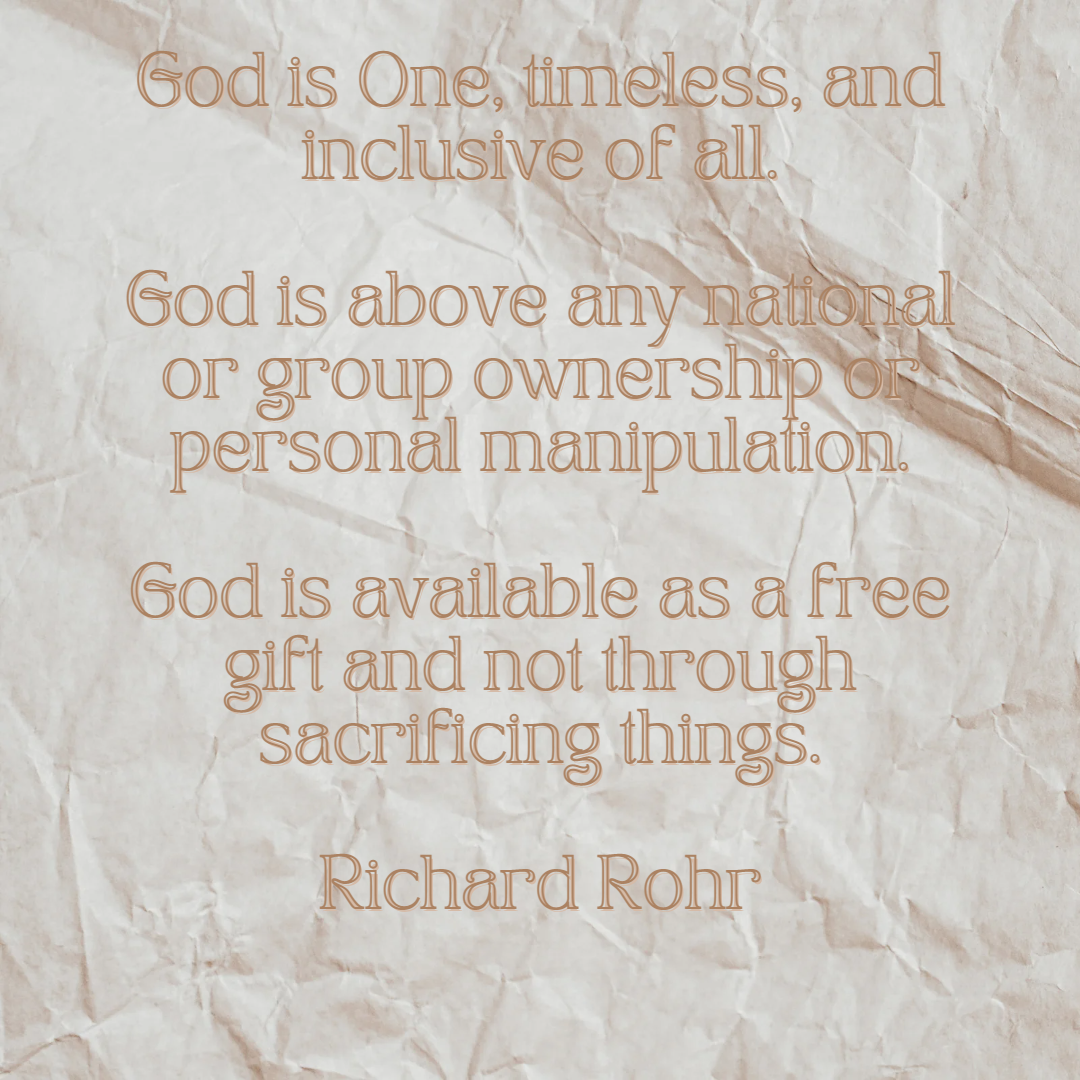
God is One, timeless, and inclusive of all.

The True Sacred, which is what you are seeking in prayer and silence, always reveals that:

God is above any national or group ownership or personal manipulation.

God is available as a free gift and not through sacrificing things.

God needs no victims and creates no victims. Jesus ends religion as sacrifice “once and for all’ by revealing the tragic effects of scapegoating through what happened to him on the cross (Hebrews 7:27, 10:10).

Jesus personifies this type of God and speaks defiantly in defense of such a God. Nowhere is he more succinct than when he quotes the prophet Hosea, “Go and learn the meaning of the words: ‘Mercy is what pleases me, not sacrifices” (Matthew 9:13).

+Adapted from Jesus’ Plan for a New World: The Sermon on the Mount, p. 5.